Nvidia's DSX POD packs an AI factory into a container, claiming 14-day setup
On October 21 Nvidia announced DSX POD at GTC Berlin: seven Vera Rubin racks pre-built in a container, a 14-day site claim, and early-2027 shipping.
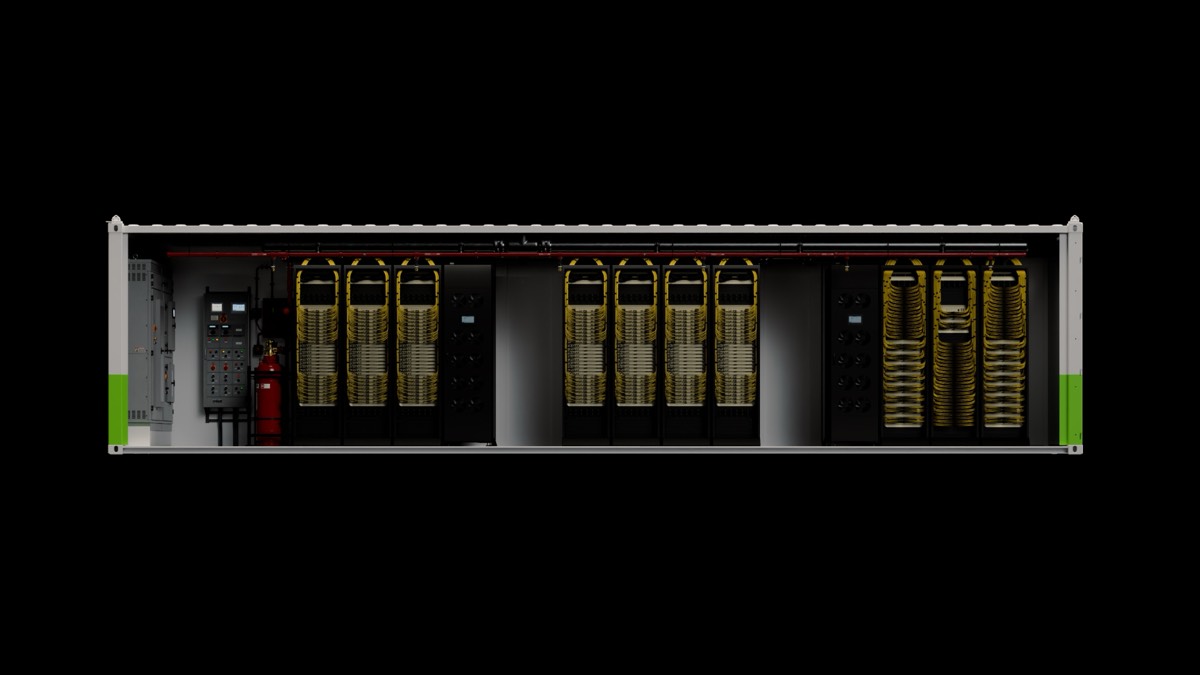
DSX POD is the AI factory reference design Nvidia announced at GTC Berlin on October 21: seven Vera Rubin NVL72 racks, plus the rack-to-rack cabling, piping, power distribution and networking, packed into a shipping container and validated as a unit before it leaves the factory. On arrival it connects to power, cooling and network the site already has. Nvidia says that at a prepared site, deployment time falls from six months to as little as 14 days. The same keynote put Vera Rubin into full production and dated the first worldwide shipments of these modular AI factories to early 2027.
Key points
- 504 GPUs to a box. One DSX POD carries seven Vera Rubin NVL72 racks, 504 GPUs and 252 Vera CPUs, at 28 metric tons, per The Register’s October 21 report.
- The 14 days has a condition. Nvidia’s release says “at a prepared site.” The Register spells out what sits outside that clock: getting the power, the connectivity and the rest of the site infrastructure ready first.
- 17 partners, early 2027. Dell, HPE, Lenovo, Schneider Electric, Vertiv, Foxconn (Ingrasys), QCT, Wistron and Eaton are among the named partners. Nvidia puts the delivery window at early 2027, worldwide.
Background
DSX POD is one delivery form of Nvidia’s larger DSX infrastructure platform. The release says the container design carries the platform’s philosophy forward, with the difference being where the integration happens: rack-to-rack cabling, wiring, piping and functional validation all move to the factory, running in parallel with site preparation. Jensen Huang’s framing on stage was that an AI factory creates value once it starts producing tokens, ahead of construction finishing.
The Berlin keynote landed at the end of a European swing. Nvidia’s own keynote blog says the company had just come through Paris, London, Stockholm and Dublin, and describes it as roughly $10 billion committed to the technology ecosystem across Europe, alongside work with more than 12,000 partners. Forrester analyst Paul Miller gave The Register a slightly more specific version: almost $10 billion invested in Europe over the past year, including 14 investments in European startups during that trip. Nvidia’s blog line carries no time span; Miller’s figure covers the past year.
Several adjacent announcements went out the same day. The OpenShell runtime that shipped in September gained a reference architecture that chains the agent runtime, Vera CPUs and BlueField-4 DPUs into one deployment recipe. The Nemotron line added embedding and reranking models for retrieval, plus Nemotron Parse for PDFs (we covered Nemotron 3.5 Super VL on October 15). Together with DSX POD they form Nvidia’s full answer to the phrase “European sovereign AI”: compute, models and governance, each layer running on Nvidia silicon.
The facts
Nvidia’s release describes DSX POD qualitatively; the hard numbers come from The Register’s on-site reporting. The table lines up what both sources support and marks which figures are the vendor’s own.
| Item | Detail | Source |
|---|---|---|
| Per pod | Seven Vera Rubin NVL72 racks, 504 GPUs, 252 Vera CPUs | The Register, Oct 21 |
| Weight | 28 metric tons | The Register, Oct 21 |
| Networking | Spectrum-X | The Register, Oct 21 |
| Cooling | Closed-loop liquid cooling, coolant up to 45°C; outdoor dry coolers reject heat to air without evaporating water | The Register, quoting Huang |
| Deployment | Six months to as little as 14 days, provided site utilities are ready | Nvidia release |
| Water | Up to 100% less cooling water | Nvidia DSX platform claim |
| Power | Same AI output with up to 30% less power | Nvidia DSX platform claim |
| Partners | 17 named in the release | Nvidia release |
| Shipping | Early 2027, worldwide | Nvidia release |
Huang also offered a scaled-up version of the water figure on stage: at 2 gigawatts, DSX could save 54 million liters of water a day. No third party has checked that number and Nvidia did not explain the conversion, so it stays a vendor claim.
Vera Rubin picked up a cloud path the same day. Per Nvidia’s blog, Google Cloud’s A5X instances are built on Vera Rubin NVL72, reach general availability next month and are slated to expand into Europe; Google Cloud plans to scale its Rubin-based footprint to as many as 960,000 GPUs across multiple sites. London-based Ineffable Intelligence, founded by AlphaGo creator David Silver, was the first A5X customer. That matters for reading DSX POD: Vera Rubin now has a rent-by-the-hour door and a buy-the-whole-box door, and Nvidia is building both at once.
What others say
The Register headlined its piece “AI trailer parks,” likening containerized datacenters to trailer-home parks. Tobias Mann’s report gives the design its due: partners validate every fitting, cable and component before shipment, so a fault surfaces in the factory rather than after a customer has finished hooking everything up. Dan Robinson’s account of the keynote states the caveat plainly: the 14 days is measured at a prepared site, and getting the power, connectivity and other site infrastructure ready first is not a small matter.
WIRED framed the announcement against European infrastructure reality, noting that infrastructure projects there are notoriously slow, which is exactly what makes the 14-day number sell. Huang also said DSX POD would cut the time compute sits idle in a datacenter, because it comes online sooner. The same piece recorded the interruption: two Greenpeace protesters stood up mid-keynote with a banner reading “Clean up your dirty business,” and Huang told his security team to “go easy” as they were escorted out.
On the sovereignty framing, Forrester’s Paul Miller supplied the cooler note: Nvidia is not a European company, and anything with critical ongoing dependencies on Nvidia, or any other non-European firm, is unlikely to meet the purest definitions of European tech sovereignty. The same test applies to DSX POD: the container could be assembled in Europe, and the chips and software inside it would still come from Nvidia.
One more detail from The Register’s OpenShell coverage is worth flagging for anyone planning to run agents on this hardware: OpenShell still has a few open security-related issues listed on GitHub. Those issues leave the DSX POD hardware delivery untouched, and they still belong on the checklist.
Our take
DSX POD changes the front half of a schedule. In a conventional AI factory build, civil works, mechanical and electrical work, rack installation, cabling and integration run in sequence, and any one of them can slip. Moving the inside-the-building portion into a factory lets integration and site preparation run in parallel. For operators and large enterprises that already have a shell building and only lack compute, that is worth real money.
For most readers the useful part is the boundary. The 14 days covers connecting the machines on a site that already has water, power, network and permits; the building itself sits outside the clock. WIRED calls European infrastructure projects notoriously slow, and grid connections and permits sit in that stretch, where a container changes nothing. Read this as a supply-chain product, and skip the framing of it as a fix for Europe’s compute bottleneck.
Three things do not appear in Nvidia’s materials: the price, the first customer to buy a DSX POD, and what permits a 28-ton container needs to cross borders. When racks actually start moving in early 2027, those numbers will surface.
What to watch
- Early 2027: DSX POD begins worldwide shipping, delivered by Dell, HPE, Lenovo, Schneider Electric, Vertiv and the other partners.
- Next month: Google Cloud’s A5X instances on Vera Rubin NVL72 reach general availability, with a planned expansion into Europe.
- Friday: Nemotron 3.5 Bolt, a 74B-parameter MoE that fits in 24 GB of VRAM, opens for download, per The Register.