Models#Benchmark#Image generation
Three mystery "aurora" models briefly appear in OpenAI's API model list, then vanish
Three aurora alpha models flashed in OpenAI's API list on October 18 and were pulled; blind testers say they generate images. Unconfirmed.
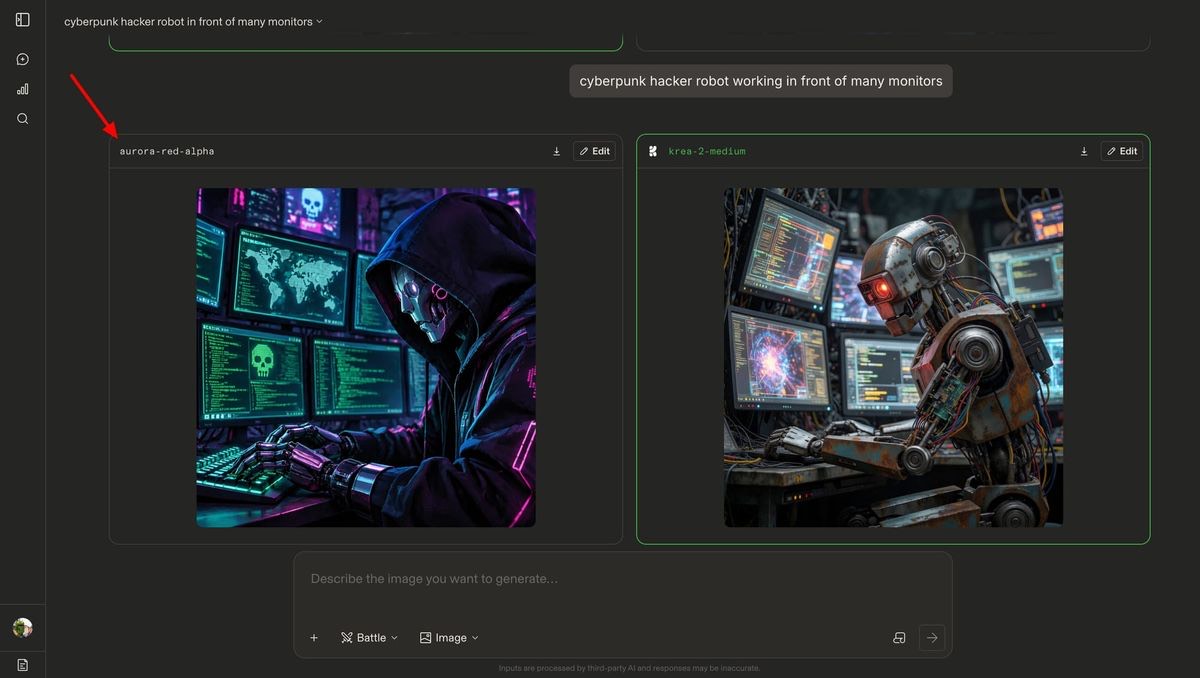
aurora-red-alpha, aurora-green-alpha and aurora-blue-alpha are three color-coded codenames for unidentified OpenAI models that briefly showed up in the API’s model list on October 18 and were pulled hours later. As of this writing, OpenAI’s official models documentation contains no aurora entries at all — we checked the page on October 19 — and the only image models it lists are GPT-Image-2.5 Sunburst and Flare. The names surfaced through two independent routes: TestingCatalog caught them via an automated alert on the Dev Mode Discord server, while X user Lumina (@LuminaBench, posting at 9:30 AM on October 18, roughly 47K views) drew them in Arena blind tests and found all three generating images. OpenAI has said nothing throughout. Both the “image models” framing and the GPT-Image-3 guess come from community blind tests and press inference, not from the company — and nothing ties that Design Arena trio to these names.
Key points
- Three entries named aurora-red-alpha, aurora-green-alpha and aurora-blue-alpha appeared in OpenAI’s API model list on October 18 and were removed within hours; the discoverers read it as an accidental rollout (TestingCatalog’s wording).
- Lumina’s Arena blind tests put red as fast but lower quality and green as slower but better looking; blue has not been drawn by any tester yet.
- The official documentation (checked October 19) lists no aurora model and no gpt-image-3; GPT-Image-2.5 Sunburst/Flare remain the only image models.
The discovery
Two channels that knew nothing of each other surfaced the names the same morning. TestingCatalog’s route was automated: a bot alert on the Dev Mode Discord server pushed “OPENAI 🔥: 3 new model references have been spotted on the APIs recently,” followed by the aurora-red/green/blue-alpha names and a note that the references were “removed shortly after” — an accidental rollout, in its reading. The Discord alert carries no public timestamp, but its one public anchor, TestingCatalog’s X post, went out at 07:42 UTC. About an hour and forty-four minutes later, Lumina posted on X that it had just drawn aurora-red-alpha in an Arena blind test (09:26 UTC, attached to a single-panel cat-portrait screenshot), then followed up with a summary post (09:30 UTC) listing all three codenames, its image a single aurora-green-alpha cat portrait. The two-panel comparison on this article’s cover — aurora-red-alpha on the left, krea-2-medium on the right — comes from TestingCatalog’s own article art.
Corroborating trivia landed the same day: X user Intius (@kdnbmb) noticed that about an hour after the API references appeared, Design Arena gained three new entries named Aspen, Cypress and Maple. TestingCatalog states plainly that “nothing ties those names to the Aurora models directly.” A pair of triplets on the same morning is a coincidence worth recording; it is not evidence of anything.
Blind-test performance
On how the models actually perform, everything traces back to one tester. In Arena’s anonymous matchups, red generated quickly at lower quality while green was slower with better-looking output; blue hasn’t come up in any test yet, so its performance is unknown. TestingCatalog, having looked at the cat portraits Lumina shared, judged them clean and detailed but said “none of them look like they’d make you write home about” — two cat images settle no quality argument.
The sample itself is a caveat. Blind tests assign models at random, testers don’t know what they drew, and the sample size depends on how long these codenames keep circulating in the Arena pool. They are gone from the API list already, and there is no public word on whether the Arena side still rotates them in. The speed-versus-quality contrast therefore rests on a handful of draws, not a benchmark.
Where the name comes from
aurora is not a fresh codename. According to Crypto Briefing, a lone aurora-alpha entry appeared on OpenRouter back in February 2026 — the label has been circulating inside OpenAI for the better part of a year. The same outlet relayed a community theory linking aurora-alpha to a GPT-5.3-Codex-Spark variant — it “remains a theory, not a fact” — and extends the speculation to this batch, suggesting the red, green and blue versions “may represent newly optimized Codex features or faster inference,” before noting that “Nobody outside OpenAI has confirmed that.” What the outlet offers as solid ground is a practical warning: an undocumented alpha with no pricing and no rate-limit notes is “not something most teams should build production systems around” — there is no way to budget for it or assess its limits.
Our take
The readers who should track this one are anyone sequencing the next wave of models for their product. The current generation, GPT-Image-2.5, shipped as two tiers — Sunburst for precision, Flare for speed — and now three color codenames appear, grouped the same way; if GPT-Image-3 follows that structure, teams that have locked in competitor pricing and tiers should leave room to re-baseline. TestingCatalog adds a supporting pattern: last week an unannounced gpt-rosalind-discovery sat on the pricing page, and Rosalind Workbench opened in research preview a day later. OpenAI’s unreleased entries have been leaking before landing repeatedly of late.
Two layers of uncertainty need to survive into any decision. The image-model framing rests on two cat pictures and one “they are all testing in arena” summary post; GPT-Image-3 is a shared guess by TestingCatalog and Lumina, and the original piece itself calls it “still a guess.” A vanished name is not a launch date — plenty of test entries simply disappear. The workable posture is to treat Arena blind tests and the official docs as observation points rather than rushing to integrate: when this ships for real, documentation, pricing and rate limits will land before any leak does. When Google shipped Nano Banana 2.1, the official docs led and pricing followed the same day — that is the repeatable pattern to watch for.