Models#Code generation#Benchmark
DeepSeek-V4.1-Flash-20261017 takes #1 open model on Code Arena WebDev at $0.3/$1.2 per M tokens
Code Arena WebDev puts DeepSeek’s new snapshot #1 among open models (1670 points) at about a tenth of Kimi K3 (Max)’s price, per Arena’s official X post.
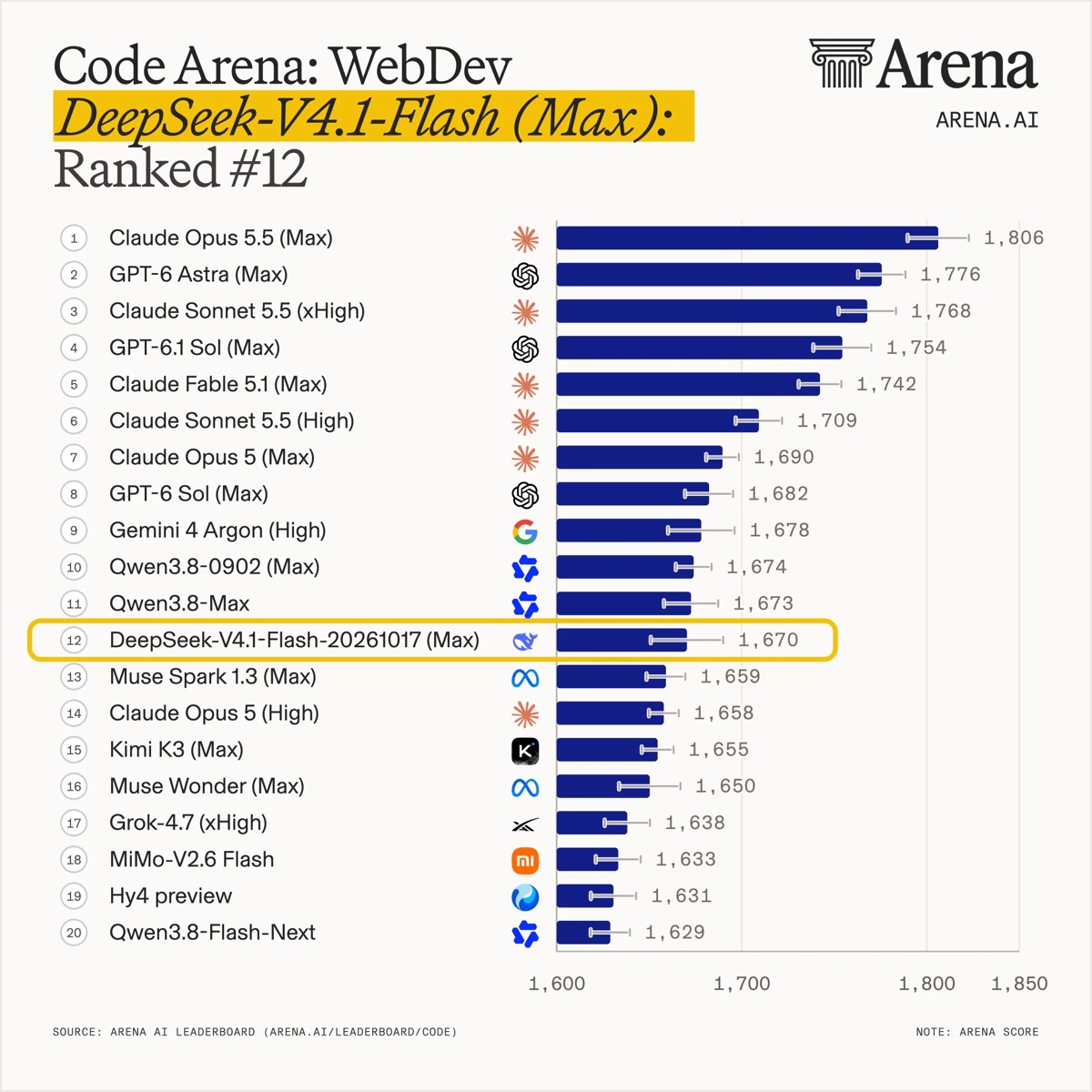
Per Arena’s official X post (October 18, 2026, 18:56 UTC), DeepSeek’s DeepSeek-V4.1-Flash-20261017 now sits at #1 among open models on Code Arena WebDev, the front-end coding leaderboard run by Arena, the company behind LMArena. The model scored 1670 points, good for #12 overall — above Claude Opus 5 (High) at #14 and about 10 points behind GPT-6 Sol (Max) at #8. It is the second event for this product line in two days: on October 17 DeepSeek published the 1017 model card on Hugging Face (our earlier report), and on October 18 a leaderboard rank plus a price point put it at the top of the open-weight coding field.
Key points
The new Code Arena WebDev order: #1 open model, #12 overall, 1670 points.
- Per Arena’s official X post, DeepSeek-V4.1-Flash-20261017 scored 1670 points — #1 open model, #12 overall. The open-model leader it displaced, Kimi K3 (Max), shows at #15 with 1655 on the accompanying chart.
- The same post lists pricing of $0.3/$1.2 per million tokens (input/output), calls it about a tenth of Kimi K3 (Max)‘s cost, and counts a 52-point gain over the prior V4.1-Flash-20260910.
- One caveat worth flagging: the chart places Qwen3.8-0902 (Max) (1,674) and Qwen3.8-Max (1,673) above DeepSeek; Arena still calls the model the top open entry without explaining how those two rows are classified.
Background
The model that lost the top open slot has its own timeline. Kimi K3, Moonshot AI’s flagship, surfaced in late September. On the agent leaderboard we covered on October 12 (data through October 8), DeepSeek V4.1 Flash ranked #17 with a 3.80% net-improvement score and Kimi K3 #18 at 3.78% — nearly side by side (our earlier report). On WebDev the two again sit at the top of the open field, and this time DeepSeek pushed Kimi off the open-weight lead.
DeepSeek’s side of the story starts two days earlier. On October 17 the V4.1 Flash 1017 model card went up on Hugging Face with 11 benchmark scores above the prior snapshot, an MIT license, 763 billion parameters and roughly 510.3 GB of weight files. DeepSeek-V4.1-Flash-20261017, the subject of this leaderboard event, is a new snapshot of the same line: the X post counts a 52-point gain over the previous 20260910 version, and the three benchmarks Crypto Briefing relays — DeepSWE v1.1 77.0, Terminal-Bench 4.0 42.3, Automation-Bench 60.5 — match the 1017 card’s figures. Whether 20261017 and 1017 are the same repo, we could not confirm directly: the 20261017 card the post points to is gated (the request returns 401), so this site could only read the 1017 card. Matching numbers do not prove a matching repository.
Arena itself has been changing. On October 8 it raised a $200 million Series B at a $3.1 billion valuation (our earlier report), and its leaderboards have expanded from blind text votes to measured real tasks, with Code Arena as the coding line.
Code Arena WebDev standings
Relevant rows per Arena’s official X post and its attached chart (scores as of the post; the arena.ai leaderboard page would not load while we wrote, so these ranks rest on the official post):
| Rank | Model | Arena score |
|---|---|---|
| 8 | GPT-6 Sol (Max) | 1,682 |
| 10 | Qwen3.8-0902 (Max) | 1,674 |
| 11 | Qwen3.8-Max | 1,673 |
| 12 | DeepSeek-V4.1-Flash-20261017 | 1,670 |
| 13 | Muse Spark 1.3 (Max) | 1,659 |
| 14 | Claude Opus 5 (High) | 1,658 |
| 15 | Kimi K3 (Max) | 1,655 |
| 16 | Muse Wonder (Max) | 1,650 |
The post’s text states the facts: 1670 points, #1 open model, #12 overall, above Claude Opus 5 (High), within about 10 points of GPT-6 Sol (Max), $0.3/$1.2 per million tokens, roughly a tenth of Kimi K3 (Max)‘s price, and 52 points over the previous version. Arena frames the combination as “shifting the performance-cost Pareto frontier for open models in coding workflows.” The chart adds per-row scores with confidence intervals.
Pricing currently rests on that single post: $0.3 per million input tokens and $1.2 per million output tokens, which Arena says is about 10x cheaper than Kimi K3 (Max). This is the leaderboard operator’s sticker price; what a coding agent actually spends per task also depends on token volume, tool calls and retries. Under the per-task-cost lens of the October 12 agent leaderboard, DeepSeek V4.1 Flash cost $0.13 against Kimi K3’s $0.94 — a gap of roughly 7x. The same model pair, two different multipliers under two different measures.
What others say
Arena’s own framing drives the story: top open model, #12, a 10x price gap, plus congratulations to DeepSeek for “another strong contribution to the open source ecosystem.” The part of that framing worth checking is the definition of “open” — two Qwen rows score higher on the same chart. One possible reading is that the (Max) tiers of Qwen3.8-0902 and Qwen3.8-Max have closed weights or sit outside the open group, but neither the post nor the chart states grouping criteria, and we could not verify it.
Independent press coverage so far consists mainly of Crypto Briefing’s October 18 report (byline Diego Almada Lopez), whose leaderboard numbers match the X post exactly and which relays architecture details from DeepSeek’s model card: a mixture-of-experts design, a 552B backbone plus 196B “Engram” parameters, 8B active during prefill and 16B during decoding, a 1M-token context. Two caveats. First, that article lists 552B and 196B separately (748B if you add them; the article gives no combined total), which does not reconcile with the 763B this site read off the readable 1017 card on October 17; we attribute each figure to its source rather than picking one. Second, Crypto Briefing is an AI desk grown out of a crypto outlet with a single byline — treat it as a second source that cross-checks the numbers, not an authority.
For Chinese-language coverage and community criticism: based on the post-level material we read and two rounds of searches in English and Chinese, we found no independent replication or challenge of the ranking; replies under the post were largely praise (one called it remarkable for a flash-tier model). The 1670 score currently has no third-party retest.
Our take
For teams running coding agents on a budget, the news here goes past “DeepSeek won”: a model at $0.3/$1.2 per million tokens now sits #12 overall on a live front-end coding leaderboard, above Claude Opus 5 (High). That moves the decision boundary. On the agent leaderboard published October 12, DeepSeek V4.1 Flash was still roughly 4x behind the leader (15.53% versus 3.80% net improvement); less than a week later, the same company’s other board puts it first among open models. If your workloads are web-front-end heavy and cost-sensitive, it is worth running your own task set against it.
Three layers of doubt to keep. First, Code Arena scores come from voluntary user-submitted battles — skewed task mix, skewed submitters, rolling updates — so 1670 is a snapshot, not a certificate; in the agent leaderboard we published on October 12 (data through October 8), DeepSeek still sat at #17. Second, the “top open model” claim collides with two higher-scoring Qwen rows, and the grouping rule is unpublished. Third, the price and the 10x gap are Arena’s annotation alone; we could not check DeepSeek’s official pricing page or Kimi K3’s current price this round (both arena.ai and the new gated model card failed to load). To try it: DeepSeek’s web app and API moved to this line on October 17 (per IT之家’s October 17 report), so run one front-end task you already know how to judge — the cost is under a dollar, which is rather the point of this story.