Spotify says it has pulled 50 million AI slop and spam tracks from recommendations this year
Spotify says it has taken more than 50 million AI slop and spam tracks out of recommendations this year. The figure is self-reported.
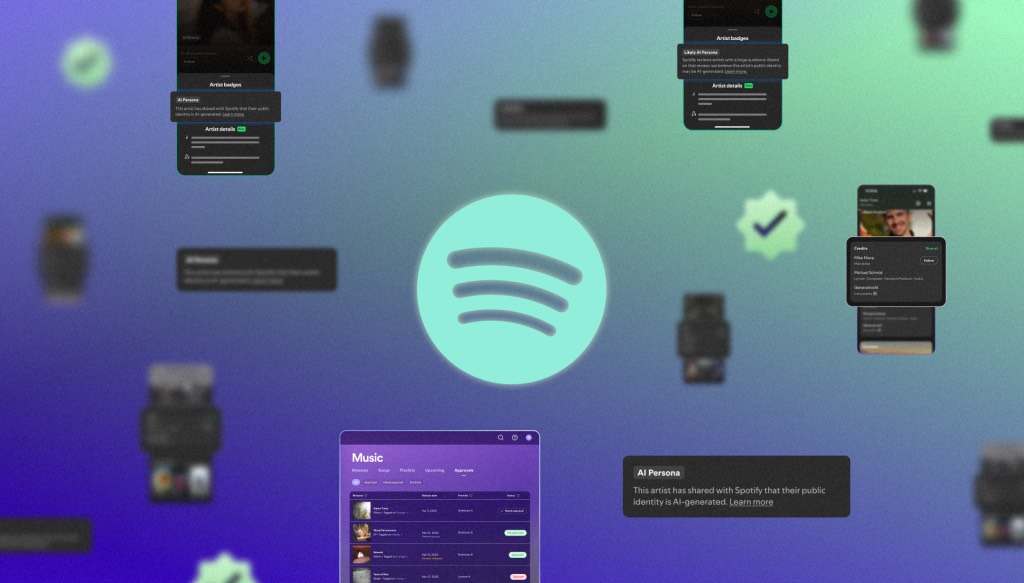
Spotify, the music streaming service, said on October 20, 2026 that it has taken more than 50 million “slop and spam” tracks out of recommendations this year. The claim comes from a one-year update titled “One Year In: Putting Human Artistry First on Spotify,” and the number is Spotify’s own. The same post covers an AI Persona badge and a royalty threshold, so it works as a summary of how the company handles AI music right now.
Key points
- Spotify says more than 50 million slop and spam tracks have come out of recommendations “this year alone.” A separate figure of more than 75 million covers tracks removed from the platform for serious or repeated violations, and the post gives no time window for it.
- Spotify combines listener engagement and feedback, upload patterns, metadata and several third-party AI detection tools. It says AI detection technology “has limitations” and will get harder as generative AI evolves.
- AI Persona profiles are excluded from editorial and algorithmic recommendations by default, unless a listener follows them. Spotify announced the rule in August and now says “thousands” of AI Personas carry the label.
Background
Spotify has been building toward this for a year. On September 25, 2025, it said that “in the past 12 months alone” it had removed over 75 million spammy tracks, and that it would help develop an industry standard, built through DDEX, for disclosing AI use in music credits. In April, it launched AI Credits, which let artists show whether vocals, lyrics or production involved AI. On August 11 it announced AI Persona badges. The badge tells listeners that an artist’s identity may be AI-generated and does not represent a real person, and it appears on profile banners, in search and on track rows in playlists. The company also said it “won’t rely on self-disclosure alone.”
We covered YouTube Music’s AI labels on October 14. That system depends on distributors declaring AI use upstream, with the platform checking whatever is left undeclared. Spotify’s badge also combines self-disclosure with review, but it covers the artist’s public identity and is handled apart from how each song was made.
The facts
Spotify’s three figures use different bases, so the table keeps them apart. The first two rows come from the October 20 post and the last from September 2025. The post does not say whether the two 75 million figures overlap.
| Figure | What it counts | Time window | Source |
|---|---|---|---|
| More than 50 million | Tracks taken out of recommendations | “This year alone” | Oct 20, 2026 post |
| More than 75 million | Tracks removed for serious or repeated violations | Not stated | Oct 20, 2026 post |
| More than 75 million | Spammy tracks removed | “Past 12 months” | Sept 25, 2025 post |
Spotify lists its inputs as “listener engagement and feedback, upload patterns, metadata, and information from multiple third-party AI detection tools.” It says “no single signal catches slop or spam on its own,” and names tactics it watches for: mass uploads, duplicates, SEO manipulation, spammy playlist networks and artificially short tracks. Its editors, the post says, “don’t program content identified as slop or spam.”
Royalties are a separate lever. The 1,000-stream royalty threshold has applied since 2024, and Spotify says tracks with strong AI indicators are “10 times more likely to fall below the threshold.” That figure also comes from Spotify, and the post offers no data behind it.
Persona labels also rest on Spotify’s own review. Its August post says the review team will identify profiles whose public identity appears to be a photorealistic AI-generated identity. Artists are notified when a badge is applied and can self-disclose or appeal. Listeners will be able to report suspected AI Persona profiles “in the coming months.”
What others say
The Duke Sanford Tech Policy Program published a blog post on October 12, 2026 describing an independent test. Five researchers used new Spotify Premium accounts for 28 days, encountered 728 artists and scored 76 of them. When they checked the flagged artists against Deezer’s AI labels, only 14% were confirmed as AI-generated. Duke reads that gap as a measure of how hard AI music is to spot without a label. Every flagged artist that Deezer confirmed surfaced through Release Radar. The blog also says Spotify’s terms of use stop individuals from applying existing detection software directly.
Music Ally (by Stuart Dredge) says the post partly answers Duke’s criticisms, though Spotify did not respond to the report directly. It also notes that the royalty threshold has drawn fire from independent labels and industry bodies, who say it hurts independent music and fear it could be raised without their consent.
Hypebot offers a competitor comparison. Deezer uses its own detection software, keeps flagged tracks out of recommendations, and offers a switch to hide AI songs. TIDAL demonetizes tracks it identifies as fully AI-generated. Hypebot also says Deezer offers its detection software free to other services. This entry has not verified that claim against Deezer’s own material.
Two reports from the same day diverge from the post. The Verge calls the window “over the past year,” where Spotify wrote “this year alone.” It also says Spotify is partnering with Universal Music Group on the remix tool, and the post does not mention UMG. Hypebot says AI Persona profiles are “automatically blocked,” and The Verge says Spotify “won’t recommend music from AI personas.” Neither mentions that a listener who follows an AI Persona still sees its music.
Our take
For artists and distributors, there is little to act on directly. Detection happens inside Spotify, and the post does not describe an appeal for tracks flagged as slop or spam. The August post does set out an appeal route for persona badges. What artists can do is submit AI Credits through their distributor or label, and review releases delivered under their name in the Artist Profile Protection beta. Spotify says that tool will reach all artists by the end of the year.
Two cautions about the numbers. The 50 million and 75 million figures are Spotify’s own, and the post gives no error rate. Duke’s test is small, with 76 scored artists, but it is the only outside check among the sources for this entry. The Release Radar finding above points at the recommendation layer Spotify says it has cleaned up, which makes it the claim most worth checking against the next update.
The royalty threshold affects income most directly and gets the least outside checking. Spotify calls it a first line of defense for human artists, but the post offers no data that outsiders can test.
What to watch
Two things. The first is when listener reports for suspected AI Persona profiles go live, which Spotify committed to in August. The second is whether Spotify explains how it counts removed tracks and how often flagged tracks still show up in recommendations. The post makes no commitment on the second, so treat it as an open question.