Videos#Code generation#Prompts#HTML to video#Motion graphics#Claude
Motion showreel prompt: an identity challenge welded to hard engineering rails
A copy-ready motion showreel prompt: an identity challenge with time-driven hard constraints. We ran it on GLM-5.3; coding models like Opus 5.5 take it well.
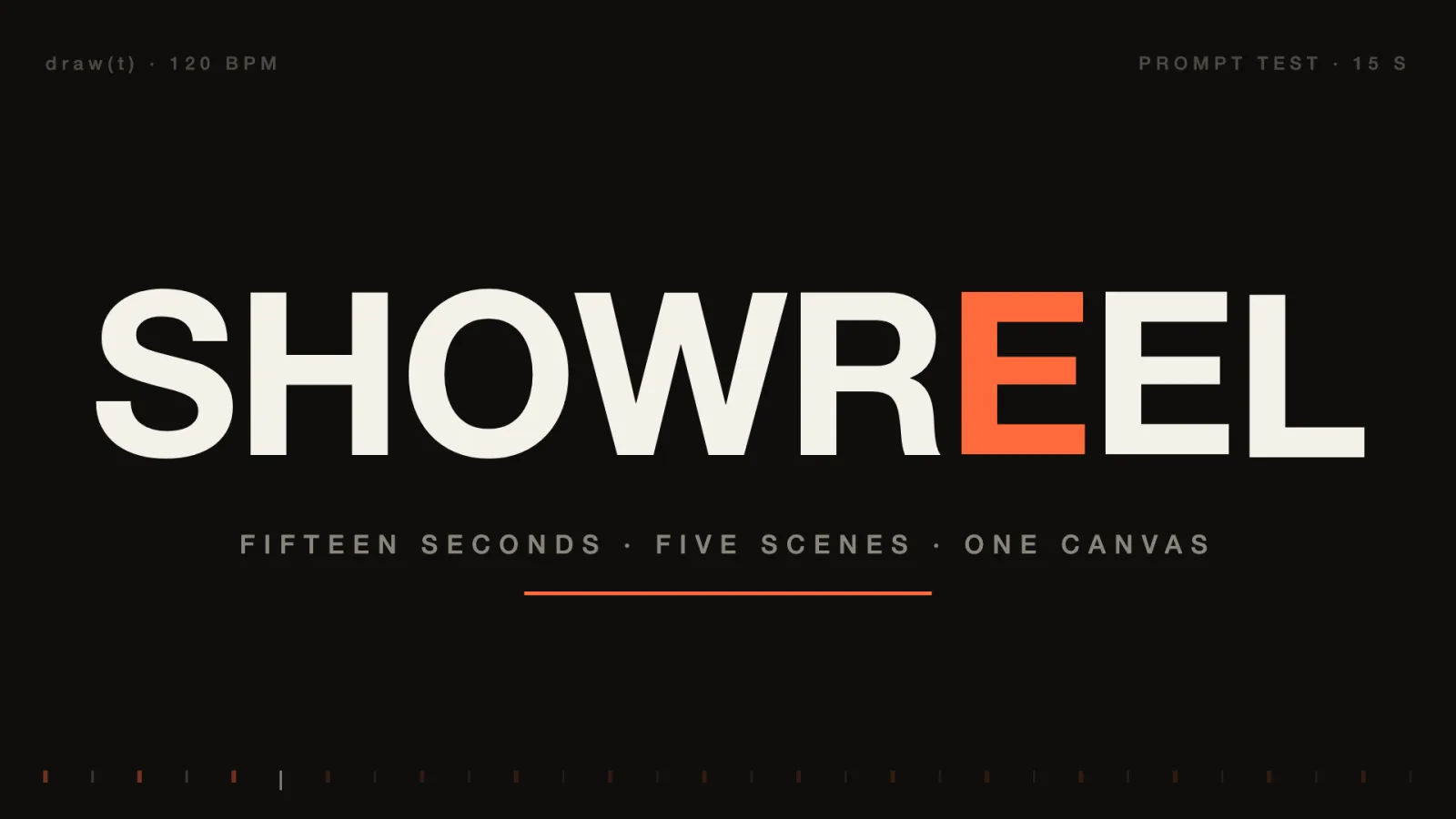 Watch the generated video · skillry.dev
ModelsGLM-5.3
The prompt
Make a 15-second motion graphics showreel good enough to get you hired at a studio you admire. Go all out, but build it like an engineer.

Canvas: one self-contained HTML file, 1920x1080, a single <canvas> where every pixel comes from one draw(t) function of time — no CSS transitions, no timers, no state carried between frames.

Rhythm: a 120 BPM beat grid, a new scene every 3 seconds, every cut and every landing on a beat.

Scenes: kinetic-type title, a bar chart that draws itself, one UI card morphing through three states under a clicking cursor, a starfield-tunnel transition, a closing signature card. Five scenes, one idea each.

Style: near-black background, one warm accent color, one geometric sans, spring easing with a tiny overshoot, real copy instead of lorem ipsum.

Loop: the last frame equals the first.
Scroll X long enough and you’ll hit an Opus 5.5 motion video with the viral one-liner in the replies: “make a dynamic 15-second motion graphics video that shows what an incredible motion designer you are.” Copy it and you’re gambling on the model: a strong one stuns, a weaker one falls back to floating-and-zooming. Write a requirements list instead and you get a stiff slide deck. This prompt welds the identity challenge to hard engineering rails: the first line gives the model an identity to defend, the rest turns random showing-off into controllable engineering.
It holds up better than either common approach:
- The identity challenge sets the ceiling. “Showreel” and “go all out” make the model reach for the motion vocabulary it has absorbed — transitions, beat grids, spring easing — which runs deeper than any adjective list.
- The rails set the floor. “One draw(t) function of time”, “a 120 BPM grid”, “the last frame equals the first” are all checkable: when a run misses one, you can point at the exact line and fix it.
- Swapping the subject touches one place. Trade the five scenes for a three-act product launch and everything else stays put, so versions stay comparable.
Details worth keeping
- “No state carried between frames” forces the animation into a pure function of time — any frame renders and checks on its own. @verbove’s template in the gallery runs on exactly this idea (sources linked above).
- “Every cut on a beat” gives each transition an objective slot, so the model never guesses “around 3 seconds”.
- “A tiny overshoot” beats “make it natural”: specifying 5–8% is what keeps springs stable.
- The two halves each have a source: the identity-challenge phrasing follows the showreel line first posted by @m1n9_k7 (the viral X post is @ajith_io’s), and the engineering constraints follow the public templates from @twoclipping and @verbove — the former asks for inputs and a storyboard first, the latter hard-codes its rules. We rewrote the prompt along the same lines and ran it on GLM-5.3; the frame above is from that run, and it links to Skillry’s side-by-side player with the original and the remake.
This is not video-model output: a coding model writes the code and the browser renders it, the same direction as our game VFX prompt breakdown — constrain the implementation instead of piling on adjectives. If you want video-model texture, this prompt won’t get you there, and long scenes lean on the model’s long-horizon execution.