craft-anything: study any site or game, have an agent rebuild it clean-room
storytold's Rust engine runs Study→Build→Check→Ready: inspect the original, an agent rebuilds it, check and refine. Apache-2.0/MIT, 9,478 stars in 4 days.
Project facts
GitHub Ecosystem- License
- Apache-2.0
- Language
- Rust
- Stars
- 9,478
- Data checked
- 2026-11-04
Snapshot figures reflect the check date and may change over time.
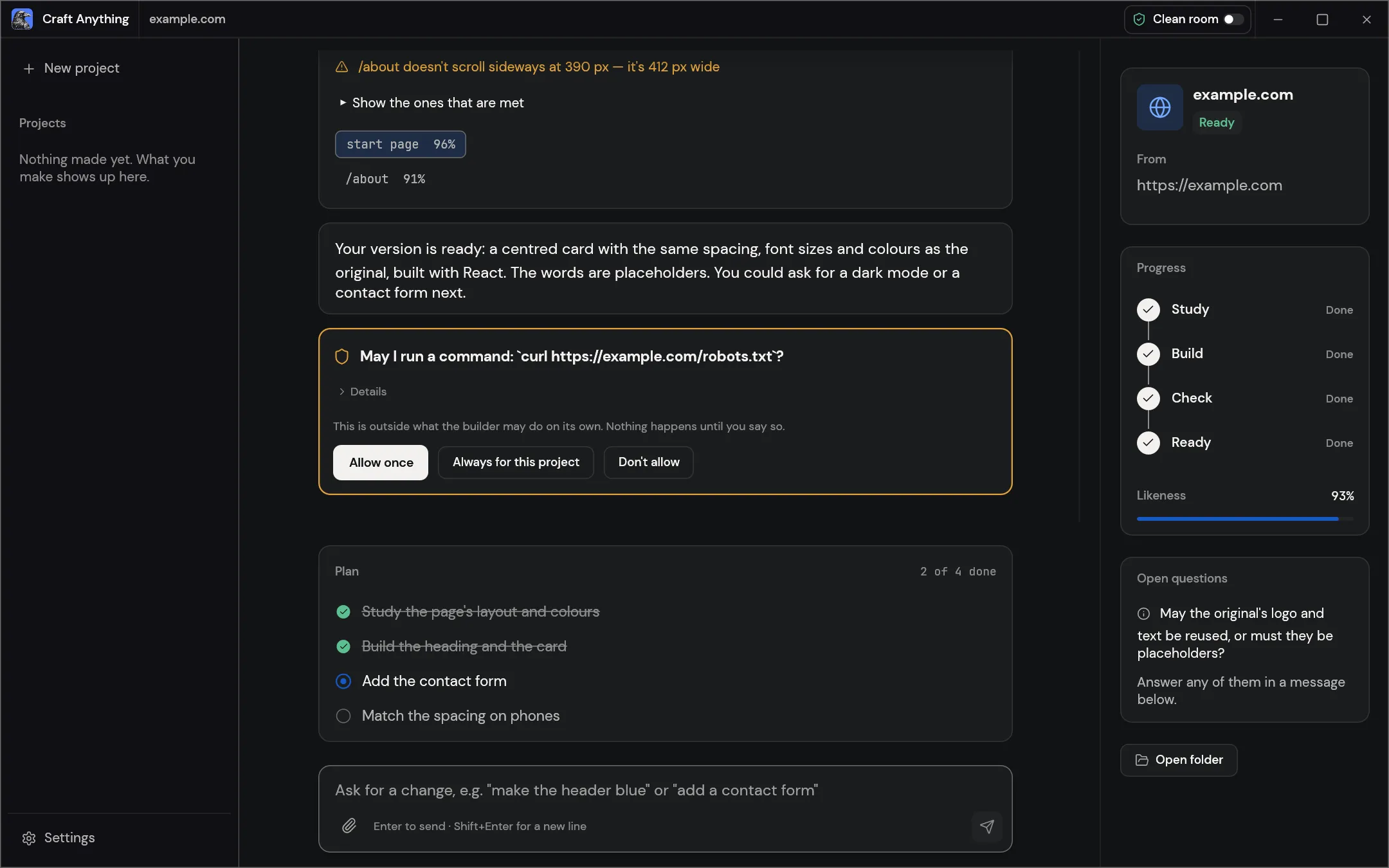
Practicing by copying a website falls apart after the first screenshot-to-AI round: it looks close on desktop, and at phone width the spacing, wrapping and menus are all wrong. Rebuilding is never about generating one version — it is about correcting against the original until it matches. craft-anything, recommended by GitHub Daily on November 4, 2026, is a clean-room rebuild engine in pure Rust from storytold (the team behind cadcraft): point it at a website, app or game, say what you want, and it runs Study→Build→Check→Ready — inspecting the original with real tools, having a coding agent build a new project, listing what doesn’t match, then refining until it opens, plays or previews. Created October 31, 2026, the repo hit 9,478 stars in four days (Apache-2.0, MIT dual-licensed); downloads at getartcraft.com.
Core features
- A four-step loop: Study inspects the original’s pages at every width, code, files and runtime; Build has a coding agent rebuild it in the language or framework you name; Check compares and lists the gaps; Ready opens, plays or keeps refining.
- Clean room by default: nothing inside the original is read — no code, files or page source. It works from what a visitor can see: screenshots, visible text, measured layout, colors, fonts, spacing, opened menus; tools that would look inside are refused, with instructions for switching.
- Deep mode: with your permission it reads program code and files (built-in engines plus Ghidra if installed), website JavaScript and the start page — for private study.
- Simple and Advanced faces: the default asks one question, “what do you want to make”; the advanced workbench exposes disassembly, pseudo-C, hex, call graphs, evidence and unknowns.
- Approval cards: anything outside the rules asks you in plain words before it runs.
Typical use cases
- Learning how something is built: the agent rebuilds a behavior-matched version and the difference list teaches you the original’s techniques — without copying its code.
- Old games and dead apps: Deep mode with Ghidra studies the old binary and produces a runnable new project.
- A front-end practice range: rebuild the same target repeatedly; the likeness score is instant grading.
Quick start
Grab an installer from getartcraft.com or the repo Releases (macOS, Windows, Linux, FreeBSD, Web), point at a target, describe what you want, press Start. It works with your own logged-in coding agent (Claude Code and similar) — the engine studies and checks, your agent writes the code.
Summary
craft-anything fits developers who want to understand how a thing works by building their own version; anyone hoping to lift someone’s code wholesale should look elsewhere — Clean room is designed to leave without the source. Facts and limits: native Rust on five platforms, Apache-2.0/MIT dual license; open-sourced October 31, 2026 and self-labeled early alpha, so interfaces will move; Clean room is a rule the tool enforces about itself, not an OS sandbox — your agent still acts with your permissions, and what it may read follows your configuration. Rebuilds are study pieces: replace assets and clear rights before shipping anything commercial. Siblings on this site: 3d-model-anything (Wes Bos’s LiDAR room rebuilds) and cadcraft (Rust-rewritten CAD) — the same study-the-original, craft-a-new-one family.