Developer tools#Coding agent#UI design
ux-ui-agent-skills: 52 objective gates that grade what your coding agent builds
Open-source XIAS: design tokens, 26 skills and 2,144 measured design systems for coding agents, then 52 gates (34 in a real browser) grade the output.
Project facts
GitHub Ecosystem- License
- MIT
- Language
- JavaScript
- Stars
- 3,052
- Data checked
- 2026-10-29
Snapshot figures reflect the check date and may change over time.
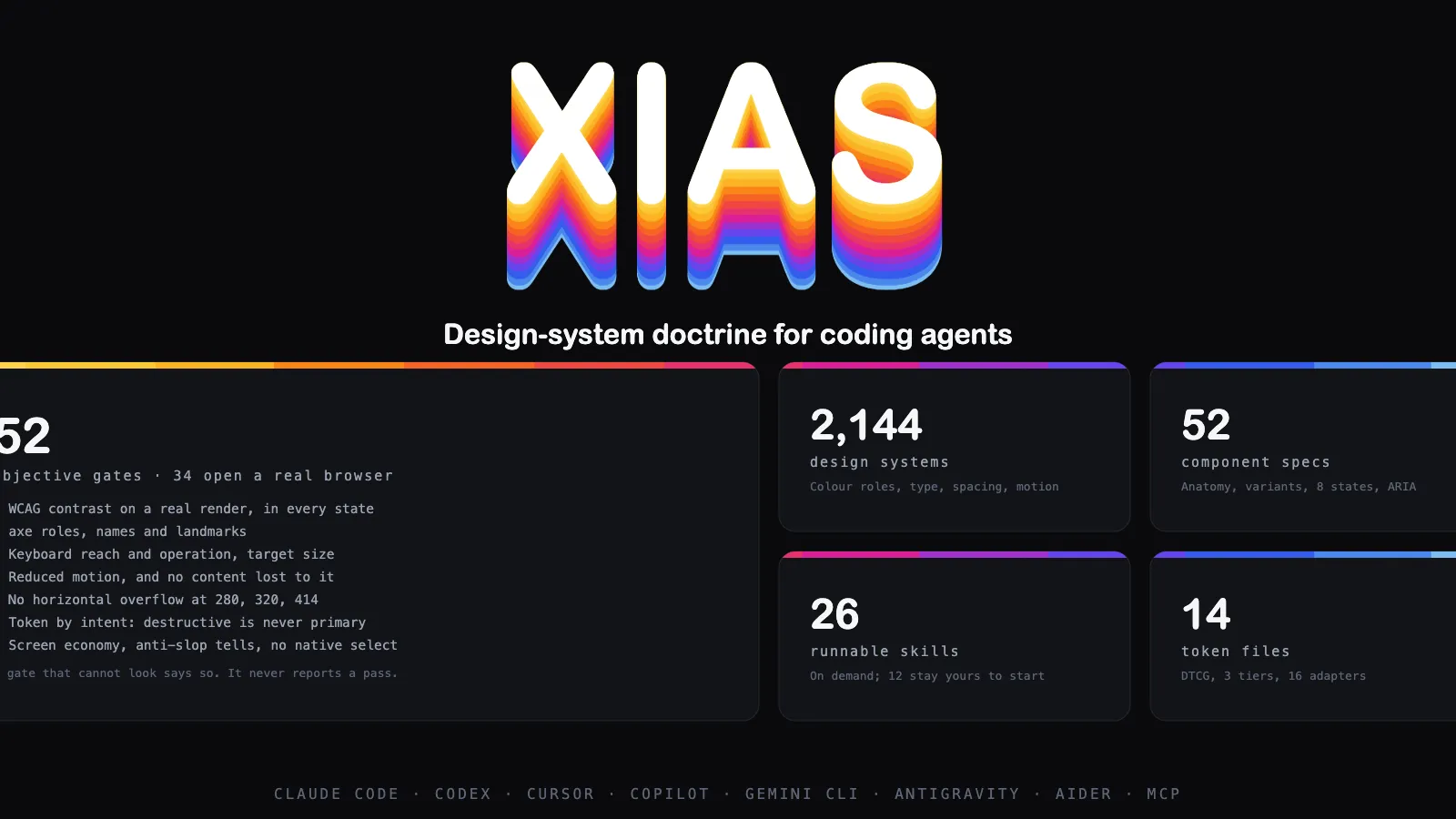
The problem with asking a coding agent to “make the UI good” is acceptance: it says it did, and your only check is eyeballing every screen. XIAS (ux-ui-agent-skills, MIT) turns both the design knowledge and the acceptance into objective measurements: the agent gets design tokens (14 DTCG files), 26 runnable skills and 2,144 design systems (2,087 of them measured from live sites); then 52 gates check what it actually built — 34 of them open a real browser to test WCAG contrast in every interactive state, axe roles and landmarks, keyboard access, target size, no horizontal overflow at 280px, reduced motion. The README’s own summary is sharp: “check what they build instead of taking their word for it.” It carries 52 component specs and 16 framework adapters (React 19, Next.js 15, SwiftUI 6, Tailwind v4…), with no build tools and no runtime — a pure instruction and knowledge layer usable in Claude Code, Codex, Cursor, Copilot and Gemini CLI. The latest release is v3.0.0 (October 26, 2026), the repo sits at 3,052 stars, and 56 gate-passing pages are browsable on the demo site.
Core features
- A design-system knowledge layer: most of the 2,144 design systems were measured off real sites (spacing, type scales, palettes), so the agent stops “guessing” brand feel from training memory.
- 52 objective gates: 34 run in a real browser executing axe, contrast, keyboard and target-size checks — fail means fail the build, leaving no room for fake success.
- 26 runnable skills: from token creation to component specs to accessibility audits, covering design through acceptance, any framework, any design system.
- Zero-dependency knowledge layer: no build tools, no runtime; install into Claude Code/Codex/Cursor and go, with 16 framework adapters governing codegen style.
Typical use cases
- A quality floor for agent-built frontends: individual developers use it to pull “AI-generated pages” up to shippable without hand-fixing every screen.
- Design-system compliance surveillance: teams with a design system whose agent code keeps drifting — gates check token by intent and fail on drift.
- Routine accessibility checks: WCAG 2.2 AA-AAA checks are built into the gates; run before merge instead of manual sampling.
Quick start
Clone the repo and install the skills the way your agent expects (Claude Code users can point straight at the skill directory); after generating output, run the gate script — failing gates produce a report. The demo site at plugin87.github.io/ux-ui-agent-skills hosts 56 fully gate-passed pages (twenty whole-product screens, five websites from a product launch to a Thai public-service page, every component harness, both themes) to compare against.
Summary
ux-ui-agent-skills fits developers who build frontends with coding agents but don’t want to be the human acceptance tester: the knowledge layer supplies taste, the gates supply the floor, and “fail the build instead of faking success” is what separates it from ordinary prompt collections. Three honest caveats: the 52 gates cover what’s objectively measurable — whether a layout is elegant still needs humans and a few heuristics; the 34 browser gates take real time per run, so run incrementally under fast iteration; and v3.0.0 is days old, with docs and adapters still moving. It complements the Claude skill collections we’ve covered before — those govern engineering discipline, XIAS governs design acceptance, and if you want both, install this one first. Comparable quantified pipelines: replica-skill turns “clone an app” into eleven skills with parity scoring, and agent-skills is Addy Osmani’s engineering-discipline collection.