knowledge-work-plugins: job-role plugins built for Claude Cowork
knowledge-work-plugins is the open-source set of job-role plugins from Anthropic for Claude Cowork, bundling skills, connectors and slash commands. Apache-2.0.
Project facts
GitHub Ecosystem- License
- Apache-2.0
- Language
- Python
- Stars
- 30,876
- Data checked
- 2026-10-21
Snapshot figures reflect the check date and may change over time.
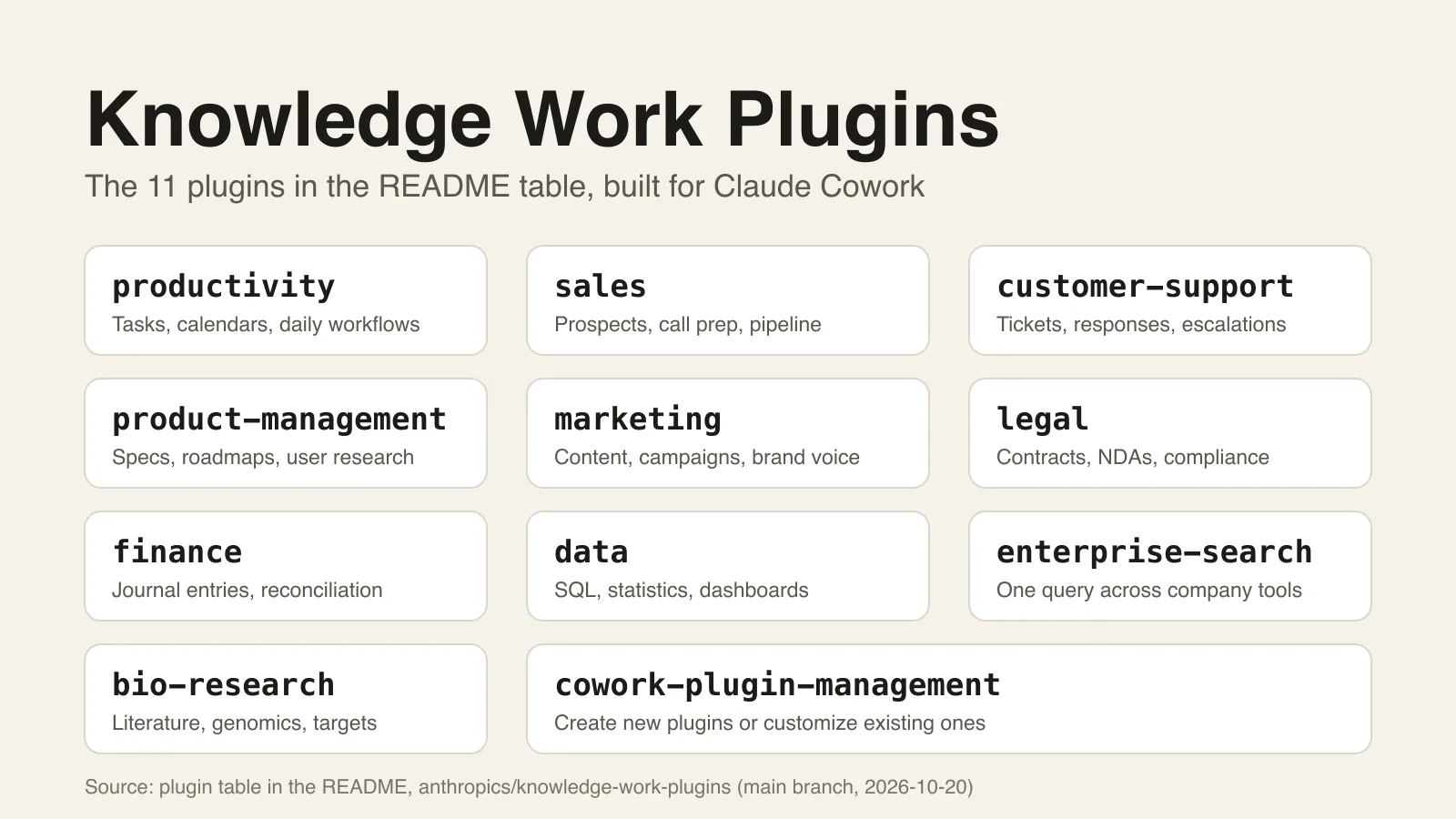
Every job has its routine. Sales reps research a prospect before a call, support agents work through a queue of tickets, and finance teams reconcile accounts at month end. The slow part is usually explaining your tools, terms and processes to the assistant again each time. knowledge-work-plugins is the open-source repository under the anthropics GitHub organization that packages those routines as plugins for Claude Cowork. The README also says the plugins work with Claude Code. As of 2026-10-21 the repository had 30,876 stars and an Apache-2.0 license.
Core features
- Eleven plugins in the README table: productivity, sales, customer-support, product-management, marketing, legal, finance, data, enterprise-search, bio-research and cowork-plugin-management. Each covers one job function. Sales, for example, handles prospect research, call preparation and pipeline review. If you prefer expert agents grouped into divisions, compare agency-agents: there the unit is a division, while here it is a job role.
- A plugin is a folder:
.claude-plugin/plugin.jsonis the manifest,.mcp.jsondeclares the connectors,commands/holds slash commands andskills/holds domain knowledge. The README says skills trigger on their own when they fit a task, while commands run only when you invoke them. Its text also says each plugin bundles sub-agents, but the structure diagram has no folder for them. - Connectors are remote MCP servers: The sales plugin’s
.mcp.jsondeclares 23 MCP servers over HTTP, pointing at endpoints such asmcp.notion.comandmcp.slack.com. The repository does not run those services. Only the Slack entry carries an OAuth configuration, and the README does not describe how the others sign in. - Made to be edited: The README suggests pointing
.mcp.jsonat your own tool stack, writing your terminology and processes into skill files, and building new plugins with cowork-plugin-management. - More folders than the table: The repository has 22 folders with a
.claude-plugin/plugin.jsonmanifest. Besides the eleven in the table, six top-level folders (design, engineering, human-resources, operations, pdf-viewer and small-business) and five underpartner-built/carry manifests. The README does not describe them, and we did not read them one by one.
Typical use cases
- A sales rep preparing for a call: pulling context on the prospect and drafting talking points, with
/sales:call-prepas the README’s example command. - A support lead clearing a backlog: triaging open tickets, drafting replies and turning a resolved issue into a knowledge base article.
- A finance team at month end: preparing journal entries, reconciling accounts and generating statements, with
/finance:reconciliationas the README’s example command. - An in-house lawyer: reviewing contracts, sorting NDAs and drafting templated responses.
Quick start
For Claude Code, the README gives these two commands:
# Add the marketplace first
claude plugin marketplace add anthropics/knowledge-work-plugins

# Then install a specific plugin
claude plugin install sales@knowledge-work-plugins
Once installed, plugins activate automatically. Skills trigger when a task calls for them, and commands such as /sales:call-prep or /data:write-query appear in the session. In Cowork, the README gives no separate install steps. It links to claude.com/plugins, which currently redirects to claude.com/marketplace/plugins. The Cowork product page says it “Works with a paid plan”, offers an upgrade link to users who are not on one, and lists Pro, Max, Team and Enterprise plans.
Summary
Good fit: teams whose daily work falls into the functions covered here and who will adapt the plugins to their own tools and processes. Poor fit: anyone who expects every connector to work on day one, or who has no access to Cowork or Claude Code. The README also calls the plugins generic starting points that work better once you adapt them to your company’s terms, structure and processes.
Three caveats apply. The repository runs nothing by itself. The README says every component is a file, with no code, no infrastructure and no build steps, so the plugins need Cowork or Claude Code to do anything. The README and the tree also disagree: the repository holds 26 .py files, 25 of them in bio-research skill scripts and one in data, and GitHub lists Python as the primary language. Finally, the connectors depend on the services behind them, and three entries in the sales .mcp.json have empty URLs, so you must fill those in before they can connect.
The repository uses the Apache-2.0 license, and its LICENSE file is the full Apache License 2.0 text. The last push was on 2026-10-20, and the README we read comes from main commit bc8f692. We read the README, the repository tree, the sales .mcp.json, the LICENSE and the Cowork product page. We did not install any plugin or run one in Cowork.