Agent frameworks#Market research
last30days: a research skill ranked by likes, not editors
last30days is an MIT-licensed agent skill that searches 30 sources, from Reddit to Polymarket, and ranks the last 30 days by engagement into a cited brief.
Project facts
GitHub Ecosystem- License
- MIT
- Language
- Python
- Stars
- 72,153
- Data checked
- 2026-11-22
Snapshot figures reflect the check date and may change over time.
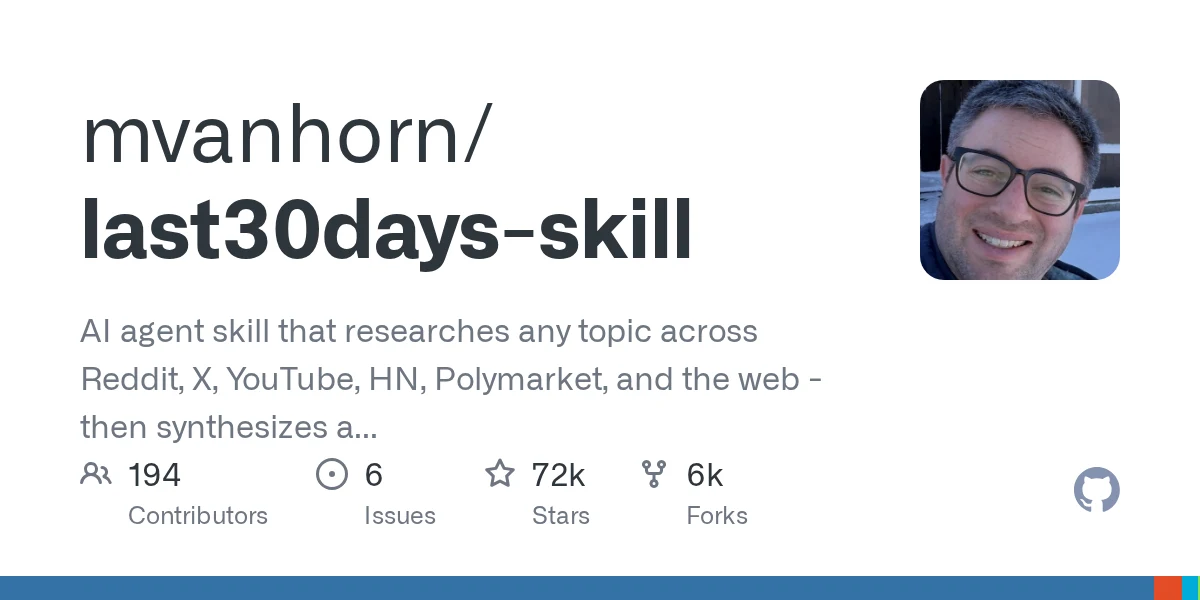
Figuring out what actually happened to a topic this month usually means a dozen tabs: top threads on Reddit, the timeline on X, a 45-minute YouTube video scrubbed for the three sentences that matter, then notes stitched together by hand. last30days is an open-source agent skill by the developer mvanhorn that searches those platforms in parallel, ranks them by engagement instead of editorial judgment, and has the host model write one brief with inline citations. As of 2026-11-22 the mvanhorn/last30days-skill repo has 72,153 stars and 6,390 forks, is MIT-licensed, lists Python as its primary language, was created on 2026-01-23, and shipped v4.6.0 the same day.
Key points
- One skill, two install paths: Claude Code takes
/plugin marketplace add mvanhorn/last30days-skillthen/plugin install last30days; 50+ other Agent Skills hosts takenpx skills add mvanhorn/last30days-skill -g. Both can coexist, but installing twice on one host gives you two/last30daysentries. - Keyless covers one tier, not everything: Reddit with comments, Hacker News, Polymarket, GitHub, StockTwits, company patents and careers pages need no key at all. X, YouTube, TikTok and Instagram need a browser session, yt-dlp or a third-party key.
- v4.6.0, released 2026-11-22, does two things: harness hooks silently capture each finished brief into a local
finished/folder, hash-deduped, andlibrary feedbuilds a local index plus an Atom feed from them. TikTok’s public comment endpoint also stopped needing a key.
Core features
The point of last30days is not that it connects more APIs. It folds evidence from unrelated platforms into one readable document while keeping the provenance of each claim.
- Parallel multi-source search: a topic fans out into several subqueries, and each subquery searches each source separately. When one story shows up on Reddit, X and YouTube, it merges into a single cluster by URL instead of three unrelated results.
- Entity resolution first: before searching, it guesses who or what you mean — X handles, GitHub repos, subreddits, TikTok hashtags, YouTube channels. The README says “Apple” resolves to the company, its site and its ticker without extra qualifiers.
- Depth lives in comments and transcripts: Reddit threads carry upvote counts, YouTube gets full transcripts mined for quotable lines, TikTok gets captions, Polymarket gets odds. It is after how people reacted, not just titles and links.
- Citations are part of the contract: the skill’s
SKILL.md(LAW 8) tells the model to inline-link every claim to the page that supports it, and a comment citation must use that comment’s own URL. The engine also saves a web-search appendix as durable evidence. These are instructions to the model, not a machine check that each link supports its sentence. - A local brief library: output defaults to
~/Documents/Last30Days/, or into SQLite with--store.library searchqueries past briefs offline, andlibrary feedwritesindex.html,feed.xmland readable brief pages. Publishing is explicit opt-in but public by default once you do it. - Hooks for scripts:
--emit=jsonreturns a versioned JSON profile, whilewatchlist.pyandbriefing.pyhandle scheduled monitoring and daily or weekly digests, so it slots into your own cron.
How ranking works
last30days promises results ranked by likes, not editors, and that promise is the most misunderstood part of the project. It does not add every platform’s applause into one global score. Each result is ranked inside its own source first (for Reddit, upvotes plus comment count), then fused by weighted reciprocal rank fusion with a smoothing constant of 60, then adjusted for lexical relevance, freshness and entity match.
- Relevance is word overlap:
relevance.pymeasures how much of the query the text covers and drops posts under a 0.1 floor. An item that misses the primary entity gets a decisive demotion that engagement cannot rescue, perCONCEPTS.md. - Loud threads get a reserved seat: within each source, a high-engagement thread that clears the relevance floor and names the entity keeps one of the top-three slots, so a heated argument almost always reaches the report.
- Per-author caps: one author gets at most three items; the subject of a person or company run gets eight. No single account can fill the brief.
The limits belong in the same section. Coordinated upvoting and brigading are not modeled; engagement measures attention, not accuracy. Web and press sources carry no engagement data and are explicitly down-weighted, so a long, worth-reading piece nobody liked sinks. Posts younger than 36 hours show a pending score and lose to older ones. And X’s official recent-search API covers roughly the last week, so without full-archive access most of a 30-day window depends on a logged-in browser session or another backend.
What works without keys
last30days calls its setup zero config, and that is narrower than it sounds. The README’s source table has 30 rows; only these need nothing at all:
| Source | What it needs | Notes |
|---|---|---|
| Reddit (with comments), Hacker News, Polymarket, GitHub, StockTwits | Nothing | Works out of the box; after Reddit site search started returning 403, a keyless web-search floor finds threads and the Arctic Shift archive fills in scores and comments |
| Company patents and careers pages | Nothing | Read automatically when the topic is a company: USPTO filings and the company’s own job board |
| arXiv, Techmeme, Yahoo Finance | Free CLIs | Installed by first-run setup, no key |
| X / Twitter | X_BEARER_TOKEN, a browser login to x.com, or XQUIK / XAI keys | The official API reaches about the last week; browser cookies are free |
| YouTube | brew install yt-dlp | Free, includes transcripts |
| TikTok, Instagram, Threads, Pinterest, LinkedIn | A ScrapeCreators key | 10,000 free calls, then pay as you go; since v4.6.0 TikTok can also fetch public comments without a key |
| Web search | A Brave key | 2,000 free queries a month |
So the honest question is what you get with nothing configured: Reddit, HN, Polymarket and GitHub, yes. Real-time X reactions and YouTube transcripts need one setup step, either a session or one binary.
Typical use cases
- Before a meeting:
/last30days <name>pulls a person’s recent posts, podcast transcripts and GitHub commits into one page — the kind of context a LinkedIn profile from 2023 will not give you. - Reading a company before it ships: a company topic automatically includes patents and careers pages. The README’s example reverse-engineers an unannounced product from a job description. Treat those signals as leads for a hypothesis, not findings; the report labels them as secret signals.
- Deciding what to write about:
/last30days what's exploding in AI agents?switches to discovery mode, sweeps listings, and returns 5–10 velocity-ranked topics, each with a follow-up query ready to run. - Comparing tools:
/last30days A vs Bruns both sub-research jobs and lays them side by side, pulling star counts live from the GitHub API instead of a blog post. - Watching a topic over time:
--storepluswatchlist.pypersists findings and can push new ones to Slack or a webhook.
Quick start
Two commands on Claude Code:
/plugin marketplace add mvanhorn/last30days-skill
/plugin install last30days
For Codex, Cursor, Copilot, Gemini CLI and other hosts:
npx skills add mvanhorn/last30days-skill -g
Then ask /last30days <topic> in a session. The first run returns a brief from the keyless sources, then offers the setup wizard for X, YouTube and the rest — the README says about 30 seconds. To see what a run would read and write before committing, run scripts/last30days.py --preflight: it does not read cookies, write files or start research.
Outside takes
The growth curve behind last30days is on the record. Trendshift’s repository page, opened on 2026-11-22, shows a first overall entry at #11 on November 17, rising to #9 on November 18 and 19, then #9–#11 through November 19, and #2 at best in the Python category. It gained 9,469 stars between September 23 and November 22, including 955 on November 18, and Trendshift logs seven days at #1 on GitHub Trending.
Hacker News is much colder. An Algolia search the same day found four submissions, none above 3 points, with no real thread. The only comment that reads like field use is a 2026-04-16 Ask HN reply where an OpenClaw user lists last30days and context-mode as the two most useful skills they had installed; everything else mentions it in passing.
ScrapingBee’s blog covered it on 2026-07-29 in a post by Karthik Devan, which recorded 54k stars at the time. The positive case is “15+ platforms, ranked by people.” The negative case is the cost of running it yourself: a key, cookie, rate limit and anti-bot story per platform, plus inconsistent formats. The post ends by selling ScrapingBee’s managed scraping API, so weigh that interest.
One more detail is worth knowing. last30days.ai is a separate site that states plainly it is unaffiliated with and not endorsed by the author. It is free, needs no account, takes 1–4 minutes per brief and connects four sources. Third parties building hosts on top is evidence of real demand; a same-name site also means someone searching “last30days” may land there instead of the repo.
Summary
last30days is for people who already work inside Claude Code or Codex and need a “what is everyone talking about this month” pass a few times a week, and who are willing to spend ten minutes on an X session or yt-dlp once. Skip it if you need reproducible academic search: word-overlap relevance plus engagement ranking is not a systematic review. Skip it too if you want a fact-checker. A citation here means “this sentence came from this link,” not “this link is true.”
It is MIT-licensed, needs Python 3.12+, and depends on yt-dlp, Node (the vendored Bird client for X search) and optionally ScrapeCreators. On 2026-11-22 it stood at 72,153 stars and 6,390 forks, with a push that day. The catches: the keyless tier scrapes public pages, so Reddit’s 403s and platform redesigns make it flaky; engagement can be gamed and nothing in the pipeline detects that; and X’s official API window never matched the “30 days” in the name.
A tool like OpenResearch turns the research process into a reproducible local bench; last30days optimizes for a brief you can read and act on, not for reproducibility. It fits naturally inside a resident assistant such as OpenClaw, where clawhub install last30days-official makes the month’s context one question away; and it does not overlap with agent-skills, which splits the whole development lifecycle into 25 skills while last30days covers retrieval only. One default to decide before installing: with no reasoning key configured, ranking stays local; add an OpenAI, xAI or OpenRouter key and the topic plus retrieved snippets go to that provider for reranking, as the data-handling section spells out.