Audio#Text to speech#Voice cloning
VoxCPM2: Tsinghua's 2B open TTS with 30-language cloning at 48kHz studio quality
Tsinghua NLP lab's open TTS: 2B params, 30 languages, voice design, controllable cloning, 48kHz output, RTF as low as 0.3. Apache-2.0.
Project facts
GitHub Ecosystem- License
- Apache-2.0
- Language
- Python
- Stars
- 41,134
- Data checked
- 2026-11-07
Snapshot figures reflect the check date and may change over time.
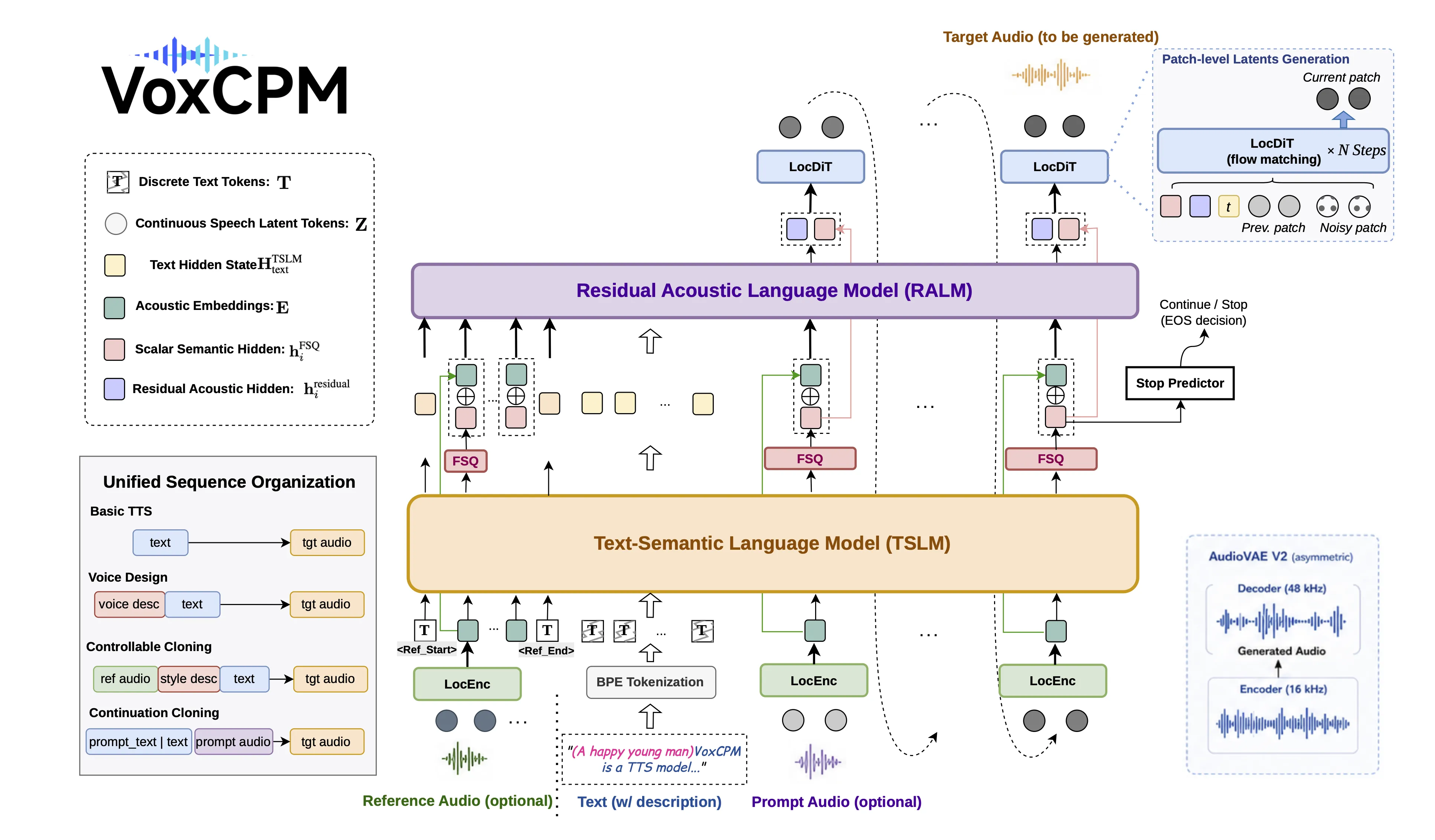
The VoxCPM series from Tsinghua’s NLP lab (OpenBMB) topped GitHub and HuggingFace Trending twice with earlier releases, and VoxCPM2 (April 2026) is the flagship: 2B parameters trained on over 2 million hours of multilingual speech, 30 languages, newly added Voice Design and controllable cloning, and 48kHz studio-quality output (Apache-2.0, 41,134 stars as of November 7; arXiv technical report 2606.06928). Deployment note: official guidance calls for at least 24GB of VRAM to run smoothly — a plain office PC will not carry it, so budget for an inference card or cloud GPU.
Core features
- Tokenizer-free architecture: continuous speech modeled directly, on a MiniCPM-4 backbone.
- 30 languages + voice design + controllable cloning: beyond standard TTS, describe the voice you want to generate a timbre, or clone from reference audio under controllable settings.
- 48kHz studio quality: output specification aligned with professional audio workflows, so post-production starts without an upsampling penalty.
- Real-time streaming: RTF as low as ~0.3 on an RTX 4090, ~0.13 accelerated by Nano-vLLM or vLLM-Omni — official omni-modal serving with PagedAttention and an OpenAI-compatible API.
- Fine-tuning friendly: SFT and LoRA scripts open-sourced since VoxCPM1.5.
Typical use cases
- Audiobook and podcast production: batch localization of multilingual spoken content.
- Voice asset design: brand or character voices designed and cloned under control.
- Real-time voice chat: streaming output plugs into realtime pipelines — RTF < 1 sustains it, and the 4090’s 0.3 leaves 3x headroom for batching.
Quick start
Python 3.10+, pip install and pull weights from HuggingFace (openbmb/VoxCPM2); an RTX 4090-class card runs streaming inference, lower-spec setups go cloud. A HuggingFace Spaces Playground lets you try before installing. The lineage is worth knowing: the 0.5B release (September 2025) and 1.5 (December 2025) each topped GitHub/HuggingFace Trending, and VoxCPM2 doubles down with 30 languages, voice design and cloning, and the 48kHz upgrade — weights, docs site, playground and an arXiv technical report all in place. Compared with the older 0.5B, the jump is not just languages: tokenizer-free modeling on the MiniCPM-4 backbone is what makes voice design (describing a voice in words) practical at all.
Summary
VoxCPM2 fits teams with GPU resources that need locally deployed, high-quality multilingual TTS; the 24GB VRAM floor keeps ordinary office PCs out — for lower budgets, community variants exist (including a 4GB Turkish-language wrapper). Facts and limits: Apache-2.0, Python, 2B parameters; voice-cloning responsibility stays with the caller — cloning someone’s voice requires their consent. VoxWeft on this site takes the on-device low-latency route for interpreting, VoxCPM2 the server-grade fidelity route — pick by deployment conditions.