CircuitHub unveils The Grid, a fully automated PCB line in Massachusetts: 4-day turnaround vs 9 from Shenzhen, $630 vs $465
CircuitHub unveiled The Grid on October 26: its robotic Massachusetts PCB line builds five 4-layer boards for $630 in 4 days; Shenzhen runs ~$465 and 9 days.
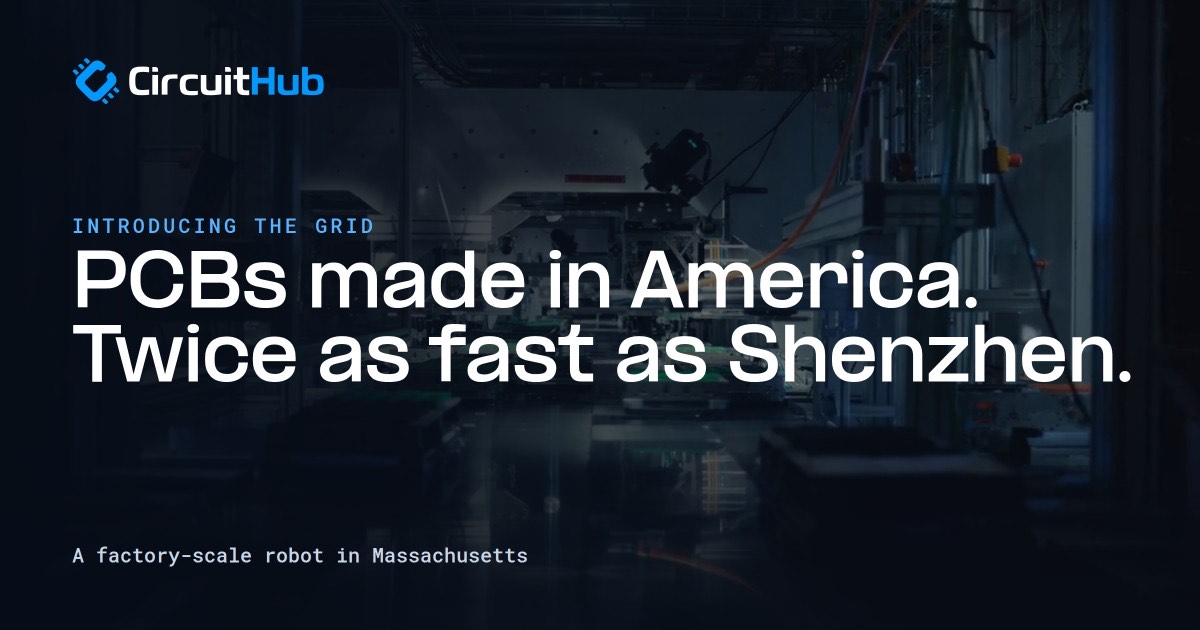
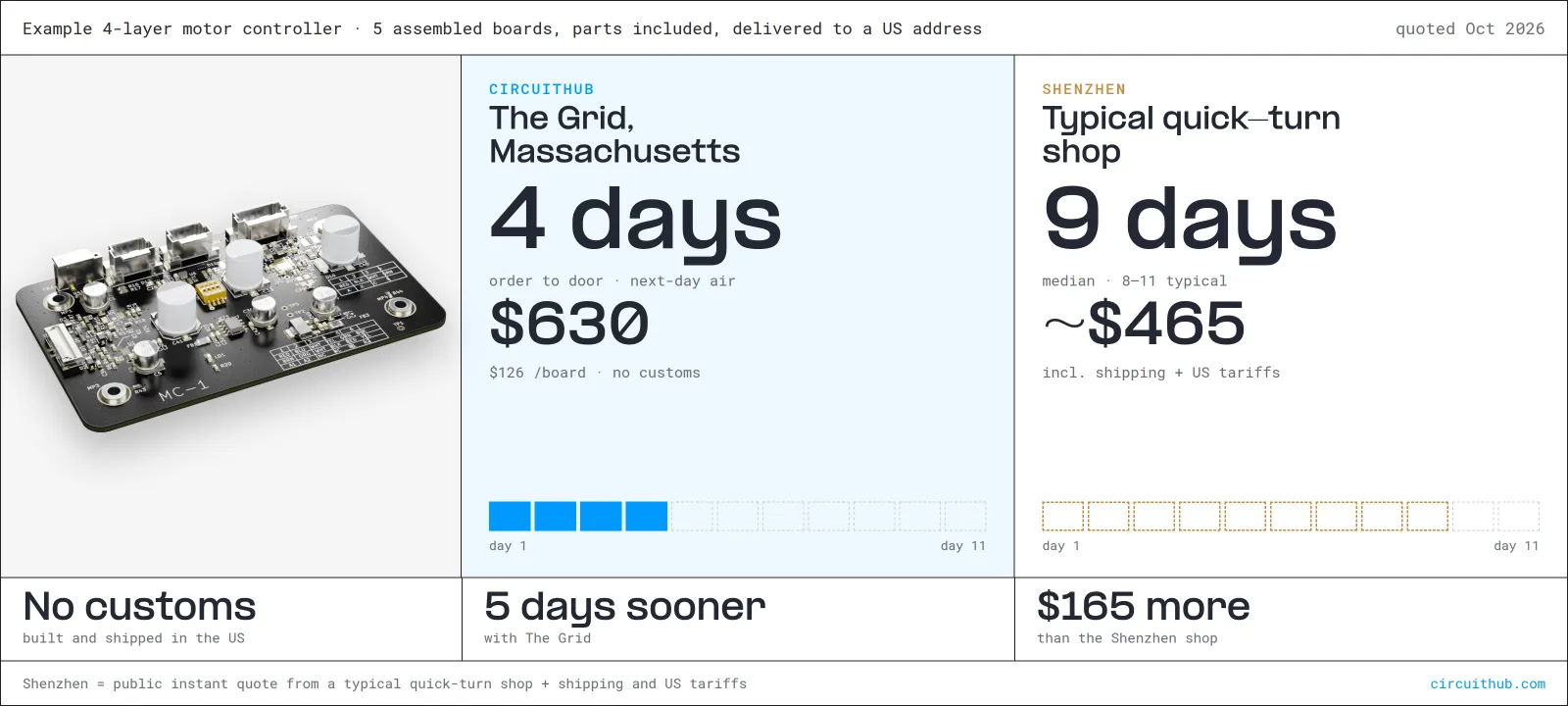
CircuitHub, a Massachusetts company, published the first public description of The Grid on October 26: a fully automated PCB assembly line where levitating movers carry each board between solder-paste printing, part placement, reflow and inspection stations, scheduled by learned models and classic optimizers with zero changeover time. The company anchors the announcement with a specific comparison — five 4-layer motor controller boards, 118 parts each, parts included, delivered to a US address, cost $630 and arrive in 4 days from The Grid; the same order from a typical Shenzhen quick-turn shop runs about $465 including shipping and US tariffs, at a 9-day median. Five days sooner, $165 more. The line has quietly served customers for five years; this is its first public appearance.
Key points
- The benchmark order: $630 and 4 days on The Grid versus ~$465 at a 9-day median from Shenzhen. Same 4-layer motor controller, five boards, 118 parts each, turnkey to a US address; the official chart lists 8–11 days as Shenzhen’s typical range (CircuitHub blog, quoted October 2026).
- The line has run for five years. The company claims over 2.2 million boards shipped, more than 150 million components placed, and 26,000+ engineers served, including “a leading EV maker, a top AI lab and household-name tech companies.”
- Capacity grew 5x this year and still trails demand. The post states “demand is already well ahead of what we can build,” with another big expansion planned for 2027.
Background
CircuitHub was founded in 2012 and runs its factory in South Deerfield, Massachusetts — about 5,000 square feet of robotic arms, computer vision and scheduling software, per Startup Fortune’s October 27 report, which also puts the company’s May 2026 Series A at $28M led by Plural (roughly $48M raised in total). The Grid itself is old news internally: the blog says it has served customers for five years, and the point of publishing now is the model. Traditional assembly houses amortize changeover cost across volume, which makes high-mix, low-volume work the worst business in the industry; The Grid’s software-defined changeovers let one prototype and a 10,000-unit batch share the same line side by side. Andrew Seddon’s post frames this as the blind spot of electronics manufacturing’s 30-year move overseas: automation only penciled out at enormous volumes — SpaceX building Starlink dishes by the million in Bastrop, Texas, is his example — while small-batch work stayed manual. Any hardware team that has waited two weeks for a prototype, then two more for the revision, knows the hole it fills.
The math
The official comparison is fully specified: 4-layer motor controller, 118 parts per board across 38 unique parts, five assembled boards, parts included, delivered to a US address. The Grid quotes $630 ($126 per board) with no customs step; the Shenzhen reference of about $465 is, per the chart’s footnote, “a public instant quote from a typical quick-turn shop + shipping and US tariffs,” with 9 days the median of an 8–11 day typical window. At company level, CircuitHub says the factory produces “tens of millions of dollars of electronics a year.”
The comparison covers small batches only. Startup Fortune notes JLCPCB advertises five prototype boards from $2 with production in as little as 24 hours; CircuitHub sells premium speed in a different price bracket entirely. The May 2025 US–China tariff truce also matters to the math — it cut US tariffs on Chinese goods from 145% to 30%, which is what keeps the $465 Shenzhen reference price plausible.
The pushback
Mydrivers, a Chinese tech outlet, ran a skeptical breakdown on October 27 with three points. First, the price gap flips at scale: $165 extra on five boards is tolerable, but the same premium on five million boards would be ruinous — CircuitHub confines itself to prototyping, R&D and low-volume work for exactly that reason. Second, small orders shipped by air from Shenzhen land in 1–3 business days, with the factory itself often shipping within days, so the real-world “five days saved” shrinks. Third, the offshoring story is oversimplified: PCB was a heavily polluting industry, and environmental pressure — labor cost alone — pushed it out of the West.
On Hacker News (October 26, 23 points, 11 comments), founder Andrew Seddon answered critics directly. An engineer posting as Teknomadix priced the site’s 4-layer boards at roughly 10x JLCPCB, adding that even paying for DHL overnight, a design goes from upload to hand in about 7 business days: “Until costs are more competitive, CN still gets the business.” Seddon’s rebuttal: within the Grid Proto spec, five 2- or 4-layer turnkey boards run “more like 1.3x, not 10x.” He also contested the shipping numbers — “7 days to the US with any consistency is not possible… median is about 10 days,” slightly more pessimistic than his own blog’s 9-day median. A US contract manufacturer (Ccecil) added the ground truth that his bare boards still come from China, and US industrial real-estate costs are a blocker nobody automates away. Positive notes came from a user (doughecka) whose prototype order was “pretty stoked how quick it is,” tariff-free compared with PCBWay.
The sources disagree on several numbers, so here they are side by side: the blog says 4 days and a 9-day Shenzhen median; Startup Fortune describes CircuitHub’s standard turnaround as three days with next-day options, and loosely calls the Shenzhen cycle six weeks; the founder himself says about 10 days. This entry takes the official blog’s 4-day and 9-day-median figures and attributes the rest to their sources.
Our take
For a hardware team revising boards weekly, The Grid converts directly into iteration speed: $165 buys a 9-day loop compressed to 4, with no customs variability in the middle. That price suits the cases where time costs more than money — a prototype before a fundraising demo, a board for a customer visit, a line-down emergency. At thousands of units a month, Shenzhen remains untouchable. The open question is whether one factory scales: capacity grew 5x this year and orders still queue, and the blog promises “another big jump coming in 2027” — Startup Fortune adds that the expansion points at the Massachusetts plant and a second facility in Europe. Whether scheduling, yield and delivery consistency survive that growth at a 4-day promise is what Startup Fortune flags as the thing to watch. The grander “rebuild Western electronics manufacturing” narrative deserves the Mydrivers caution: automating the prototype niche and reshoring consumer-electronics volume are separated by orders of magnitude in cost. Earlier this month, OpenAI listed 19 robotics roles stretching from actuators to manufacturing — the story of bringing hardware production back to America has plenty of tellers this year, and very few who can show the unit economics.
What to watch
The blog commits to two checkable nodes: the “another big jump coming in 2027” expansion — which Startup Fortune says points at the Massachusetts plant and a second facility in Europe — and a demand backlog that persists today. Hobbyist and consumer orders, asked about on HN, have no announced timeline. Tariffs are the other moving part — the post-truce rates hang on temporary extensions, and the Shenzhen reference price will drift with them.