Products#Code generation#Benchmark
Epic ships a 'vibe coded' launcher preview; Fortnite heads to Linux as EAC gets rebuilt
Epic's launcher Preview, rebuilt by a small team with AI, cold-starts in 5.47s vs Steam's 10.07s in Epic-commissioned tests; Fortnite follows on EAC Linux v2.
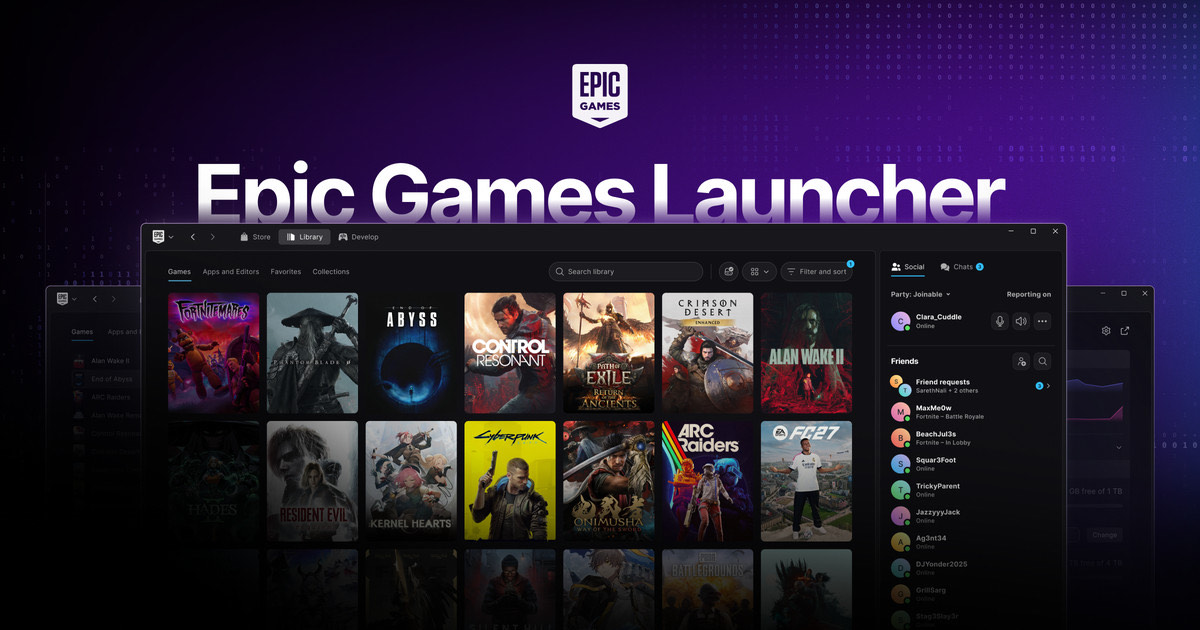
On October 14, Epic Games shipped a Preview of its rebuilt Epic Games Launcher — the store and library client that has been around since the Epic Games Store launched in December 2018, now rewritten from scratch by a small team working with generative AI. The preview covers Windows and macOS and, for the first time, Linux. The boldest number sits right on the official page: an average 5.47-second cold start against Steam’s 10.07 — with a footnote conceding the tests were commissioned by Epic.
Key points
- The launch post’s own words: “programming is hard. So, instead of doing that, we vibe coded a new Epic Games Launcher.”
- The page’s footnote says the comparison numbers come from Keywords Studios, a third party Epic commissioned: five runs per machine across 13 machines in October 2026, with the three lowest-end machines excluded, and “individual results will vary.”
- To bring Fortnite to Linux, Epic is rebuilding Easy Anti-Cheat: EAC Linux v2 pairs a signed kernel and signed kernel modules with secure boot and attestation, and lands only once enough distro maintainers accept its security requirements.
Background
The old launcher has fronted the Epic Games Store since December 2018, and Epic has wanted it gone for a while. At Unreal Fest in June it showed the rewrite and promised cold starts up to 5x faster; the preview’s official page now settles for “1.8x faster startup than Steam.”
The bigger backdrop is Epic’s own pivot. Days before the launch, Bloomberg reported that Epic is moving a Star Wars and Marvel-themed shooter to an “AI first” development model, and CEO Tim Sweeney followed up saying Epic has “a huge pivot underway,” retooling developers “for maximum AI acceleration.” Big studios folding AI coding into their workflow is no longer news by itself — we recently looked at what Claude Code did to US developer hiring, where postings went up rather than down (our coverage of the Indeed data).
How fast is it
Every speed number comes from the official launcher page:
| Metric | New launcher | Steam |
|---|---|---|
| Cold start | 5.47 s | 10.07 s |
| Background to library | 0.36 s | 0.42 s |
| Store open | 3x faster | — |
| Library load | 30x faster | — |
The footnote spells out the method: Keywords Studios tested in October 2026, averaged five runs per machine, worked across 13 machines and dropped the three lowest-end ones from the averages.
The preview is visibly unfinished. Epic says it “will have some bugs,” ships light on features, and is missing some social and account features on the way to parity with the old client; what’s genuinely new is a Recent Games list and a centralized downloads hub. On Linux, the supported list is Ubuntu 22.04 LTS, Fedora 43 and Debian 12 or newer — and GamingOnLinux’s author, who installed the preview, found Windows games running through the GE-Proton compatibility layer under the user’s compat/runtime path.
Rebuilding anti-cheat
Alongside the preview, Epic announced a ground-up rebuild of Easy Anti-Cheat for Linux, branded EAC Linux v2: a signed kernel, signed kernel modules and secure boot with attestation, meant to approach the protection Windows players already get. The security requirements were drawn up with distro maintainers, and the improvements will later be offered to other multiplayer developers.
Fortnite will be the pilot — shipped first, tested in the wild, then rolled out wider. The gate is practical: Epic wants a “critical mass of distro maintainers” on board before launch, and plans a panel with the Fedora Project Leader this year on fair competitive gaming on Linux. The Steam Deck is the obvious gap: Epic says it currently lacks the features EAC v2 needs, and talks with Valve are underway. Cheating is also why Fortnite stayed off Linux for so long — Sweeney had said Epic wasn’t confident it could fight cheating at scale across the many kernel configurations Linux ships.
What others say
Ars Technica tested the preview on launch day. Cold start really is a few seconds faster than Steam, as long as a login or update hiccup doesn’t get in the way; the 0.06-second tray-to-library difference Epic’s numbers tout was unnoticeable in Ars’s runs. Martin Keely, GM and VP of the Epic Games Store, told PC Gamer that the team started from scratch on a different tech stack, using AI to “write and review new features and new capabilities,” and told IGN that AI coding “made us more efficient and allowed a small team to rewrite the code base” — Ars relayed both interviews.
How literally to read “vibe coded” is already an argument. Commenters on GamingOnLinux take it as a joke; The Verge and PC Gamer reported it straight. Epic hasn’t clarified, and the post supports both readings.
Our take
The number to remember here isn’t 5.47 seconds — it’s the vocabulary. Individual developers have been rebuilding old games in the browser for a while; this is the first time a platform-scale company has put “vibe coding” in a launch post, comparison numbers attached. Read those numbers with the footnote in mind: a commissioned benchmark is still a commissioned benchmark, Ars’s testing confirmed only the cold-start gap, and “30x faster” library loads or a 0.06-second edge won’t change how a launcher feels day to day.
For Linux players, the consequential piece is EAC v2, not the launcher: if it lands, Fortnite becomes the first mainstream battle royale to reach Linux behind a kernel-level anti-cheat, and the rest of the Linux anti-cheat ecosystem gets a template to copy or reject. For everyone else, the preview installs today but stays feature-light — waiting for parity is the cheaper move. What’s unknown: when EAC v2 actually ships, whether the Steam Deck qualifies, and whether “vibe coded” was literal. All three are worth watching more than the benchmark table.