GPT-6 rolls out with Intelligent UI
Sol for paid tiers, Luna for free: answers now mix charts, forms, buttons and inline tools for 1.2B users.
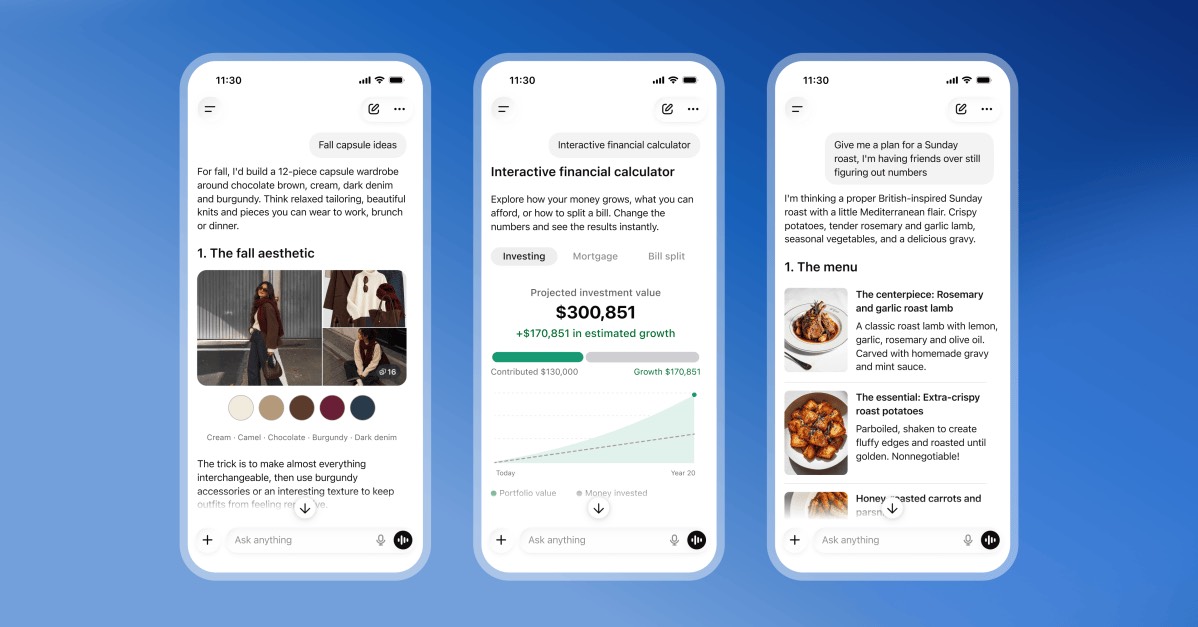
OpenAI announced “GPT-6 for everyone” on October 7: GPT-6 is now rolling out to all ChatGPT users — paid tiers (Plus, Pro, Business, Enterprise) get GPT-6 Sol the same day, with free and Go users moving to the more efficient GPT-6 Luna on Thursday. Shipping alongside is “Intelligent UI”: answers that mix charts, forms, tappable buttons and inline tools on demand — official demos include an interactive seven-speed bicycle diagram, a categorized Mahjong tutorial, a retirement-savings calculator and a bill splitter. OpenAI says GPT-6 was trained on when and how to substitute interactive visuals for prose, alongside better web search, faster partial answers, and “stronger resistance to attempts to bypass its safety training.”
Key points
- Scope: all 1.2 billion ChatGPT users; GPT-6 Sol for paid tiers, GPT-6 Luna for free and Go
- Intelligent UI: text + charts + forms + tappable buttons + inline tools (calculators, mini-games) in one answer
- Training: models specifically learned when and how to render interactive visuals instead of plain text
- Also: improved web search, quicker partial answers while gathering info, hardened against jailbreaks (deployment-safety page updated)
- Cadence: paid tiers day one; free and Go follow on Thursday
The chat box, retired as a form factor
Intelligent UI turns each answer into a one-shot generated micro-app: users ask for the thing itself, not a description of it. That is a structural shift — conversational AI moves from “text stream with sidebars” to generative UI, summarized by Gizmodo’s headline that OpenAI wants ChatGPT to stop looking like a chatbot. For developers, ChatGPT becomes a low-code delivery surface: the market for small tools like retirement calculators is being absorbed into the conversation — a single-answer demo can now do what a utility app’s entire pitch did, and utility apps’ moats get one layer thinner with each rollout.
A competitive necessity, not a flourish
The build-up was visible: Meta’s Muse contesting the consumer entry point, image ads needing richer placements, and Haiku 5.5 flooring small-model prices the same day — the contest for the conversational entry point has widened from model quality to interface experience and cost structure. Giving free users Luna rather than Sol continues the quality-tier-and-convert playbook.
Sol, Luna, and the free-tier math
Giving free users Luna rather than Sol continues the quality-tier-and-convert playbook, but the naming signals intent: Luna is positioned as the efficiency tier that keeps GPT-6’s core abilities at a cost free users can be served at — on the same day Anthropic’s Haiku 5.5 attacked the small-model floor, the “good enough” line for free is being raised from both sides at once. OpenAI’s deployment-safety page was updated with Sol and Luna evaluations the same hour, and jailbreak resistance appeared in launch messaging — a first for a consumer rollout.
The ecosystem question
The demos matter less individually than as a set: charts carry data, forms take input, buttons perform actions, inline tools compute — together, one answer can carry a complete small business process. The open question is openness. If the Intelligent UI component protocol opens to third parties, ChatGPT becomes an app-distribution channel and the ad inventory story changes shape; if it stays closed, this is an experience upgrade inside OpenAI’s own walls. The precedent of SynthID and watermarking suggests OpenAI’s instinct on presentation-layer control is firm.
From chat to delivery surface
For users, answers become operable; for the ecosystem, the open question is whether Intelligent UI components open to third parties — the precedents of ads and SynthID watermarking suggest OpenAI will not surrender the presentation layer. The number to watch: free-tier week-two retention after the rollout. If interactive answers move it, the interface revolution stands; if the components amount to dressing text up as cards, it will be remembered as interface cosmetics.