Research#Multi-agent#Data analysis
OpenAI, PerturbAI and Scripps ran 1,946 GPT-Rosalind agents over a whole-mouse-brain CRISPR atlas
1,946 GPT-Rosalind agents, one per gene, reanalyzed a mouse whole-brain CRISPR atlas in 32 minutes; OpenAI, PerturbAI and Scripps published the reports.
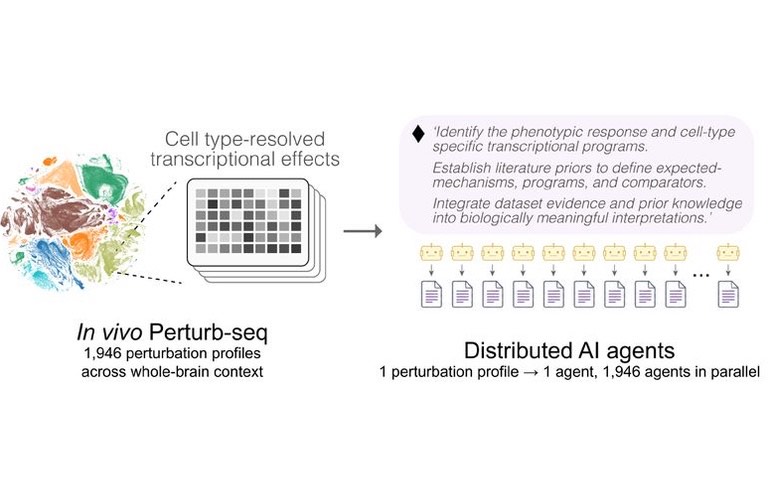
On October 21, 2026, OpenAI, PerturbAI and Scripps Research reported a joint result: they split an already-public whole-mouse-brain CRISPR perturbation atlas into 1,946 slices, gave each gene perturbation its own GPT-Rosalind agent, and had each agent read its slice, search the literature and write a mechanistic hypothesis. The parallel run finished in 32 minutes, and the reports were merged into a public “reasoning atlas.” The three partners call the approach distributed biological reasoning. The preprint went up on bioRxiv on October 16 (2026.10.15.759436, v1, CC-BY), the code is on GitHub under MIT, and the atlas data is CC-BY-4.0.
Key points
- Division of labour: 1,946 agents each took one perturbation, sharing a single prompt, one tool set and one code environment; the preprint records the parallel run as 32 minutes.
- Literature: across the run the agents logged 39,185 paper reads and kept 16,445 citations. At the largest workload of 893 perturbations, the single-agent control cited 11 references while the distributed runs kept 711 times as many (Fig. 2E).
- Recovery: of 71 source-study conclusions, agents matched 35, refined 13 and partially recovered 9 without seeing the manuscript. Of the 55 findings derivable from differential expression alone, 48 were matched or refined (87.3%), and 52 counting partial recoveries (94.5%).
Background
The atlas being analyzed is not new. The Jin lab’s Shi et al. used an enhanced in vivo Perturb-seq platform to knock out 1,947 disease-associated genes and profile more than 7.7 million cells, posting the work to bioRxiv in March 2026 (2026.03.16.711480, page dated March 18). On Hugging Face the dataset splits into two configurations — 7,720,300 rows in default and 19,070 in gene_metadata, per the datasets-server — and its 350 files total 204,953,167,236 bytes, about 205 GB.
Experiments like this produce tens of thousands of perturbation-by-cell-type responses. Conventional statistics return differential-expression lists, modules and perturbation similarities; turning those into mechanistic hypotheses means connecting them to knowledge scattered across decades of literature. The paper’s framing is that the ability to run experiments keeps expanding while the capacity to interpret them stays bounded by human experts. GPT-Rosalind is OpenAI’s life-sciences model, announced April 16, 2026, and out of research preview into trusted access since September 11. This run used GPT-Rosalind-5.5, whose stated knowledge cutoff of December 2025 predates the source manuscript — which is what makes the “it never saw the answers” claim checkable.
A related claim landed earlier this year: on September 30 we covered Anthropic’s roughly 950 Claude agents finding a CRISPR-like system, where the discovery is still waiting on bench validation. This paper goes the other way, reading existing experimental data more thoroughly.
How the work was split
One agent owns one perturbation. It receives cell-type-resolved differential-expression profiles, the experimental context, and a shared prompt plus a code environment with analysis tools and literature access. It can inspect the data, compare perturbations and run its own analyses. The output is a structured report: findings, quantitative evidence such as log fold change, biological interpretation, references, caveats and proposed follow-up experiments. Reports go into a searchable database and a knowledge graph whose nodes are perturbations, findings, genes, pathways, cell types and supporting evidence.
The single-agent control is the part worth studying. Model, prompt, reasoning settings, tools and data access were all held fixed; the only variable was whether one agent carried all 893 perturbations or each perturbation got its own. That turns “what does the multi-agent setup actually buy” into something measurable: citation volume, the distribution of literature labels, and human preference.
Literature labelling adds a second layer. A downstream agent tags each finding as agree (direct literature support), inferred (mechanistic support without a directly matching observation), disagree (conflicts with a literature-derived expectation) or no literature (no precedent retrieved). Of 1,519 high-confidence findings, 420 were agree (27.6%), 636 inferred (41.9%), 101 disagree (6.6%) and 362 had no retrieved precedent (23.8%). The paper is explicit that “no literature” marks a retrieval gap, not proof that no relevant study exists.
The facts
The numbers come in three layers: scheduling scale, recovery scores and predictive skill. The table follows the preprint text and figure captions, and the repository’s raw JSON reconciles with it.
| Item | Value | Source |
|---|---|---|
| Agents | 1,946, one per gene perturbation | Preprint text, Fig. 1A |
| Parallel runtime | 32 minutes | Preprint text, Fig. 2D |
| Paper reads logged | 39,185 | Text; repo source_access_summary.json |
| Citations retained | 16,445 | Same |
| Single-agent control | 11 references at 893 perturbations; distributed kept 711x as many | Fig. 2E |
| Source conclusions | 35 matched, 13 refined, 9 partially recovered, 14 uncovered of 71 | Fig. 1C |
| The 55 directly testable | 48 matched or refined (87.3%); 52 with partial recoveries (94.5%) | Text |
| Blinded review | 30 doctoral experts scored 60 reports; a separate 20-pair comparison, three reviewers each, preferred distributed reports 45/60 times (75%) | Fig. 4H–4K |
| Held-out prediction | 272 held-out perturbations, balanced accuracy 0.705 | Fig. 3 |
| Depletion ranking | median recall@50 of 0.36; single agent 0.18, DepMap 0.26, DEG magnitude 0.14 | Fig. 3K |
The blinded review published its correlations too: agent novelty scores tracked mean human novelty scores at Spearman ρ=0.61, follow-up priority at ρ=0.56 and evidential support at ρ=0.49. In that separate 20-pair comparison, single-agent reports were preferred 10 times (16.7%) and 5 were ties.
The synthesis stage has its own numbers. Cross-perturbation synthesis produced 3,397 normalized, deduplicated relational findings, with a priority-score median of 0.05 and mean of 0.46 — attention collapses onto a small candidate set. When perturbation identities were shuffled while keeping the transcriptional profiles, the agree share fell from 29.3% to 13.2% (within-screen shuffle) and 6.1% (out-of-screen genes), while no-literature rose from 29.9% to 43.5% and 61.0%. Pathway summaries were also more compact: a median of five genes per pathway against 19 for enrichment-based summaries, with canonical-pathway direction agreeing in 96.2% of matched comparisons.
Limits and version notes
First, “months to a year” is an estimate, not a measurement. The Fig. 2D caption reads: “Human estimates assume $22/hour, 15 minutes to interpret one perturbation, and 10 minutes per paper read; this is not a measured human performance.” Treating it as a human baseline result contradicts the paper’s own note.
Second, three citation totals measure three different things, and it is easy to compare them by mistake. R&D World’s October 21 report says the distributed agents “retained 7,586 references, approximately 711 times as many, according to the project’s public data” — the hedge matters. The preprint’s running total is 16,445 retained citations from 39,185 paper reads across the whole run. The 7,586 figure is the 893-perturbation comparison slice: the repo’s data/tables/scaling/replot_single_vs_multi_layered.csv lists 7,586 references for each of the three multi seeds at scale 893, against 11, 11 and 10 for the three single seeds. Summing data/inputs/literature/source_access_per_report.csv over the 893 genes in data/runs/scaling/seed-017/n0893/targets.json lands on exactly 7,586 citation entries, with 7,528 in the cited_sources column. That column counts report-source pairs, not distinct sources: the repo’s source_access_summary.json sets counting_unit to “report-source pair; duplicates across reports count separately,” and 72 of the 2,046 rows have fewer cited_sources than citation_entries (Arhgef9 is 6 against 7). All 2,046 rows sum to 16,555 entries and 16,445 pairs. And 7,586 ÷ 10.67 (the mean of 11, 11 and 10) = 711.2, which is where the “approximately 711 times” comes from. So the paper’s 711x and R&D World’s 7,586 agree; what they are not is the same number as the run-wide 16,445. Note also that 7,586 is printed only in the repo’s scaling table: the preprint’s prose and captions never state it, and neither per-report CSV contains the string — it can only be recovered by summing the rows, and not finding it by search does not mean it is unsourced. OpenAI’s own post says “more than 700.”
Third, one atlas was tested. Held-out prediction reached balanced accuracy 0.705, with misses and overcalls. Pomp, Thoc2 and Pafah1b1 were predicted to produce 600, 303 and 40 differentially expressed genes respectively and produced zero — and all three ranked among the strongest depletion hits. The authors’ explanation is that strongly affected cells were not recovered for profiling; that is a hypothesis, not a finding.
Fourth, the most publicized lead cannot be credited to the distributed architecture. R&D World states plainly that “the study’s single-agent baseline also generated a lead that interested the experts.” Three blinded reviewers gave that DCTN1/cholesterol finding a mean follow-up priority of 4.3 out of 5. Both things are true at once.
Fifth, authors and review status: six authors are OpenAI employees and two are PerturbAI employees; Grace X. Y. Zheng and Xin Jin are PerturbAI co-founders. The preprint has not been peer reviewed.
Sixth, the perturbation count is 1,946, not 1,947. The source atlas describes 1,947 disease-associated genes; this run launched 1,946 agents. The two numbers should not be mixed.
What others say
R&D World’s Brian Buntz (October 21) frames the work as a proof of concept and notes that the comparison with human analysts “rests on the time estimate above.” He singles out the blinded score on the DCTN1 lead — a mean follow-up priority of 4.3 out of 5 — and the testable question it raises about whether impaired cholesterol transport triggers a compensatory synthesis program in neurons.
Tom’s Guide’s October 22 piece is written for a general audience and adds its own disclaimer: “AI has not discovered a cure for Alzheimer’s or Parkinson’s disease.” It stresses that these are early leads scientists still have to test, and it never uses the 1,946 figure, saying “thousands of AI agents” throughout.
Hacker News had the sharpest objections. The thread stood at 146 points and 96 comments when checked on October 22, and the recurring complaint was that leads are not the bottleneck. User mdevere argued that clinical development is, and that plenty of well-funded AI drug-discovery companies already hold no shortage of candidate targets. pcrh looked up DCTN1 on GeneCards and noted the Parkinson’s-like association is long established. Metacelsus questioned the efficiency of one agent per gene “unless the goal is to spend millions in API credits.” Some aimed at the press release rather than the paper: anthuswilliams called it “one of the laziest and nonsensical press releases I have ever seen attached to a scientific paper,” while conceding the linked paper “is not exactly transformative, but the impression it leaves is quite a bit better.”
Peer review is the cleanest comparison. On October 13 we covered AlphaProof Nexus solving Erdős problems in Science — a version that cleared review. This one is still a v1 preprint. On the engineering side, Anthropic’s dynamic workflows is the same shape — a controller writes the orchestration, subagents fan out — except it dispatches by program where this dispatches by data slice.
Our take
Copy the shape, not the conclusions. Slice a large perturbation atlas by perturbation, let each agent see only its own cell, hold the tooling constant, emit structured reports, then synthesize across them. That pattern transfers to any dataset where rows are experimental conditions and columns are measurements. The three control numbers give it a verifiable skeleton: citation volume held as workload grew, a 75% preference in blinded pairs, and 87.3% recovery of directly testable conclusions. The raw material for all three is in the repository and anyone can recompute it.
The honest side: this is a reanalysis of data published in March 2026, not new experimental work; the human-hours comparison is an estimate; one atlas was tested; predictions overcall in depleted cells; and the headline biological lead turned up in the single-agent baseline too. Taken together, it demonstrates that interpretation can be parallelized. It does not demonstrate that AI produced a biological discovery, and it says nothing about treating Alzheimer’s or Parkinson’s.
Who should care: a lab sitting on single-cell or perturbation-screen data with no dedicated interpretation staff can ask the MCP endpoint a handful of questions with known answers and see how it does. Engineers building agent orchestration should read the distributed_agent prompts and report schema — that is the least copyable part of the method. If a dataset has only a few dozen conditions, a single agent plus human review is less trouble; the payoff here grows with the number of perturbations.
How to try it
The fastest route is the hosted site named in the repo README, a temporary address while the custom domain is unavailable: https://sites-publish-check-20261021.as-alexander-sun.chatgpt.site. It needs no install and serves the reports and the knowledge graph.
To wire the corpus into your own assistant, the README gives two MCP commands:
codex mcp add distributed-agents-shi \
  --url https://sites-publish-check-20261021.as-alexander-sun.chatgpt.site/api/shi-mcp
Running locally needs pixi and the Codex CLI, then pixi install -e minimal and codex login:
pixi run -e minimal distributed_agents query \
  "What is the relationship between the proteasome subunits?" \
  --out-dir runs/starter
Large files come through Git LFS (git lfs pull). The raw atlas lives on Hugging Face as perturbai/wholebrain_crispr_atlas, CC-BY-4.0, about 205 GB — downloading only what you need beats cloning the whole thing. The hosted service omits the raw data files, so any question that requires recomputing statistics has to run locally.