AMD launches EPYC Embedded 9006, up to 256 Zen 6 cores
AMD announced its Zen 6 EPYC Embedded 9006 series on November 10, with up to 256 cores, PCIe Gen 6 and CXL 3.1; the first model is scheduled for November 15.
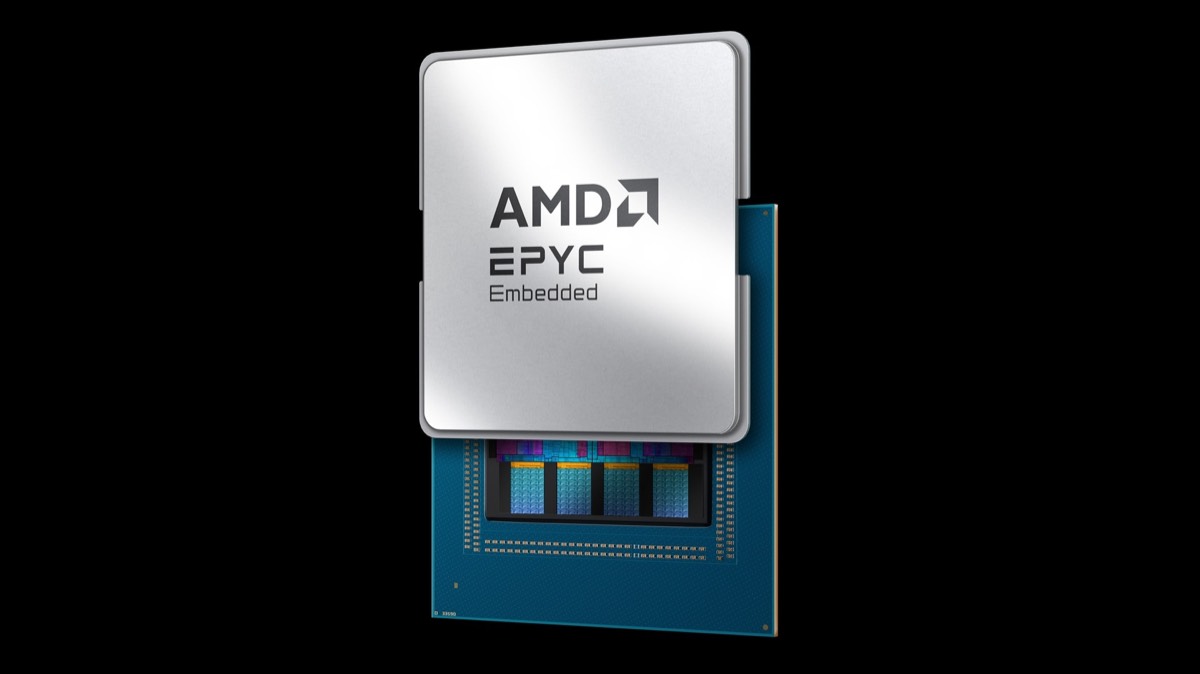
AMD announced its sixth-generation EPYC Embedded 9006 processor family on November 10, 2026. Based on Zen 6, the series reaches 256 cores and 512 threads per processor and adds PCIe Gen 6 and CXL 3.1 to the embedded lineup. IT之家 dates its report to November 11, while AMD’s newsroom release says November 10; this entry uses the date on AMD’s original announcement and records the discrepancy. For teams building industrial, networking, or storage equipment, the concrete change is a higher core ceiling alongside more memory channels and newer I/O. A platform move from the previous generation still needs careful board and system planning.
Key points
- AMD identifies the 9006 as its sixth-generation EPYC Embedded family, based on Zen 6 and built for the SP7 platform.
- The lineup spans 64 to 256 cores, with up to 512 threads in the top configuration.
- Each processor supports 16 DDR5 memory channels, up to 96 PCIe Gen 6 lanes, and CXL 3.1.
Background
EPYC Embedded targets equipment with long service lives, where a processor change can involve a board redesign and years of qualification work. AMD announced its fifth-generation Embedded 9005 series in 2025 on SP5, with up to 192 cores in a single socket and a seven-year product support commitment. The new 9006 moves to SP7. IT之家 reports that SP7 and SP5 use different sockets, so an existing 9005 board cannot accept a 9006 processor as a drop-in upgrade. Buyers should treat this as a platform transition and recheck board layout, power delivery, cooling, memory, and expansion cards.
AMD names semiconductor automated test equipment, enterprise storage controllers, and network firewalls as target systems. SiliconANGLE adds context around parallel processing in chip test equipment and rising traffic demands on network and storage systems. Those are useful clues about the intended workloads, but they do not establish that every such system benefits from a high-core-count CPU. Our earlier report on AMD’s data center business covers a broader server and accelerator market; Embedded 9006 is a distinct product line with its own platform and longevity requirements.
Specifications
EPYC Embedded 9006 combines a higher core ceiling with more memory channels and newer host I/O. The figures below come from AMD’s November 10 announcement. Its throughput and bandwidth multipliers are vendor comparisons, and this reporting found no independent 9006 benchmark results.
| Item | EPYC Embedded 9006 | Notes |
|---|---|---|
| Architecture and platform | Zen 6, SP7 | Sixth-generation Embedded series |
| Cores and threads | 64–256 cores; up to 512 threads | Maximum per processor |
| Memory | 16 DDR5 channels | RDIMM up to 8,000 MT/s; MRDIMM up to 12,800 MT/s |
| Expansion | Up to 96 PCIe Gen 6 lanes; CXL 3.1 | PCIe signaling up to 64 GT/s |
| Product support | Seven-year product longevity commitment | Intended for long-lived embedded equipment |
| Initial availability | 128-core model scheduled from November 15, 2026 | Other SKUs expected to begin shipping by year-end |
AMD says memory bandwidth can reach 2.7 times the prior generation, I/O bandwidth 1.5 times, and throughput in selected workloads 1.8 times. IT之家 provides an arithmetic comparison of theoretical memory bandwidth: 12,800 MT/s MRDIMM for 9006 gives a calculated 1,638 GB/s, compared with 614 GB/s using the outlet’s 6,400 MT/s figure for the previous generation. These are theoretical bandwidth figures derived from the memory rate and channel configuration. They do not predict application throughput on a particular system. AMD’s multipliers likewise remain vendor claims until reproduced under disclosed, comparable test conditions.
Other reporting
The independent coverage adds product context and makes the verification limits clearer. Phoronix lists six models—9976, 9946, 9846, 9756, 9656, and 9556—with core counts from 64 to 256. It says it had no Embedded 9006 hardware available for benchmarking or Linux testing. Phoronix also reports a 600 W TDP and up to 4.1 GHz for the top model. Those model details should be checked against the final SKU documentation before a system design relies on them; they do not tell us sustained power draw or performance in a customer chassis.
SiliconANGLE discusses the series in the context of semiconductor test systems, storage, and firewalls, and relays AMD’s performance positioning for those workloads. Its report is useful for understanding where the company expects the chip to fit, but it does not provide third-party measurements. We found no independent test comparing an Embedded 9006 and Embedded 9005 with the same software, memory configuration, and power limits. Nor did we find measured power, throughput, or latency from a finished customer system. AMD’s product page timed out during this research, so the launch announcement remains the primary source for the listed specifications.
There is also a date mismatch in the coverage. AMD’s newsroom page gives November 10, 2026, as the announcement date; IT之家 labels its report November 11. Neither page explains the difference, which could reflect a publication update or time-zone convention. The available evidence does not establish the cause, so we use AMD’s original release date for the event date and state the outlet’s date as printed.
Our take
If you are designing a new chip-test system, storage controller, or high-end firewall, 9006 is worth evaluating on platform fit. Sixteen DDR5 channels, CXL 3.1, and PCIe Gen 6 offer room for different memory and device configurations, while a 256-core ceiling gives highly parallel workloads another CPU option. Compared with the SpacemiT V100 server processor, 9006 is an x86 embedded product with an announced first-ship schedule; their software ecosystems and intended systems differ, so core counts alone do not make them performance peers.
A useful evaluation starts with practical constraints. Can the product move to SP7? Will the workload use the additional memory channels or new I/O? Does the system’s power and thermal envelope permit a high-core-count configuration to sustain useful work? The announcement does not include pricing, and the first 128-core model is only scheduled to become available on November 15. AMD’s seven-year longevity commitment also does not guarantee that every system vendor will provide firmware maintenance or spare parts for the same period.
For now, OEMs can begin compatibility planning and request system quotes, but AMD’s “up to 1.8×” figure should not replace workload testing. A meaningful comparison should hold memory type and speed, core count, cooling and power limits, compiler, and application version constant. Measure sustained throughput per watt as well as peak throughput. Results from the specific board, BIOS, and sample are what will determine whether the upgrade fits a product; launch-day specifications cannot answer that on their own.