Bank of Korea: a US AI-spending slowdown could cut Korean chip exports by up to $100B against forecasts
Bank of Korea's Oct 26 reply to parliament models a US AI-capex slowdown that cuts chip exports $50–100B below forecast and 2027 GDP by 0.4 points.
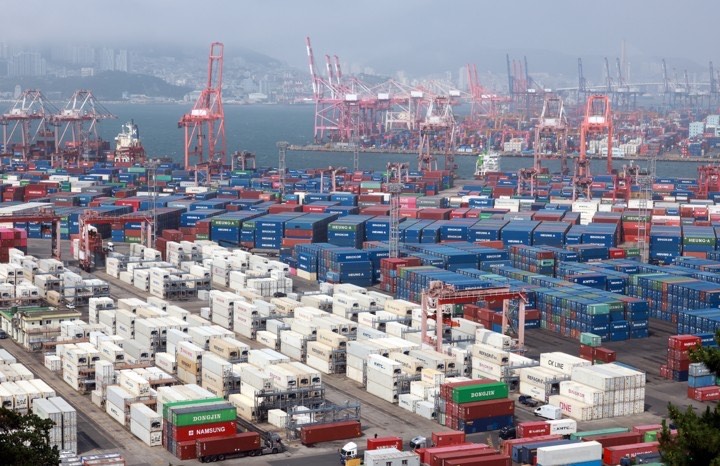
The Bank of Korea put a number on the fear every chip exporter has been carrying: in a written reply to South Korea’s National Assembly dated October 26, the central bank modelled a pessimistic scenario in which US tech giants — Amazon, Microsoft, Meta among them — rein in AI infrastructure spending next year, cutting Korean semiconductor exports $50–100 billion below forecast. The top of that range is about a sixth of the bank’s $600 billion chip-export projection. Maeil Business Newspaper (매일경제) broke the story exclusively at 17:32 KST that day; per Reuters’ relay the following day, the reply went to lawmaker Ahn Do-geol — Maeil’s own text names no lawmaker — and the two reports agree on every headline figure. A pessimistic scenario the bank had sketched in its August outlook — direction only, no numbers — is now on paper for the first time.
Key points
- A $50–100B export gap. In the scenario, 2027 semiconductor exports fall that far short of the central bank’s $600B projection — and chips make up roughly half of all Korean exports.
- Growth and surplus take the hit together. Next year’s GDP growth drops about 0.4 percentage points, the 2027 current-account surplus lands well below the $430B projection, and the won faces added depreciation pressure.
- Two assumptions carry the scenario. Export volume growth eases from the low-to-mid 10% range to around 10%, and unit prices come in roughly 10% below expectations — the price-led boom is exactly where the bank sees the fragility.
Background
Export structure is the starting point for the warning. Citing Korea’s Ministry of Trade, Industry and Energy, Maeil Business reports that from January to September this year, exports of cars, auto parts and consumer appliances all ran below the same period a year earlier — outside chips, Korea has no second industry big enough to absorb the shock. The $430B surplus projection sounds enormous, but it tracks the boom: August alone booked a current-account surplus of roughly $46.1B, the second-highest on record, driven largely by semiconductors (preliminary August balance-of-payments data the Bank of Korea released on October 8). The bank drew a pessimistic scenario in its August outlook without publishing figures; tabling them in a parliamentary audit reply effectively moves the stress test into the open.
The same central bank also reported, on October 27, that third-quarter GDP grew 1.0% quarter-on-quarter — more than triple its own forecast, powered by semiconductor exports and equipment investment, while private consumption fell 0.2%, per multiple Korean outlets on October 27 including Yonhap News and Newsis. Boom and fragility are the same coin. The financing behind that capex has been this site’s running beat: Meta’s equity raise of up to $95B, SpaceX’s $40B GPU-backed debt, and a memory shortage now expected to run through 2028 that explains why chip exports are riding prices as much as volumes. What the Bank of Korea did is follow the money one step further — from cloud vendors’ balance sheets to a sovereign economy’s GDP.
Scenario assumptions
The pessimistic scenario rests on a stated set of assumptions, corroborated across the two reports:
| Item | Baseline | Pessimistic scenario | Source |
|---|---|---|---|
| 2027 semiconductor exports | $600B | down $50–100B | Maeil |
| Export volume growth | low-to-mid 10% range | around 10% | Maeil |
| Semiconductor unit price | — | ~10% below expectation | Maeil, Reuters |
| 2027 GDP growth | — | down ~0.4pp | Reuters |
| 2027 current-account surplus | $430B | “well below” that projection | Maeil, Reuters |
| Korean won | — | added depreciation pressure | Maeil |
One detail the two reports do not align on: the Reuters copy cites only a 10% price decline, while Maeil adds the volume assumption — growth easing from the low-to-mid 10% range to around 10%. This entry follows Maeil’s fuller version. Two caveats belong here as well: the original BOK reply has not been published (parliamentary audit materials usually surface via the lawmaker’s office), so the figures rest on the two outlets’ reporting; and the Reuters copy’s line about the big five’s combined capex “growing from $40B last year to a projected $110B next year” contradicts the spending those companies have already disclosed — Meta alone has filed for AI-related financing of up to $95B — and looks like a transcription or translation error, so this entry does not use that series.
What others say
Wall Street has not turned with the warning. Per Zhitong Caijing (October 27), Goldman Sachs cut its 12-month KOSPI target from 12,000 to 9,000 — yet the new target still implies roughly 60% upside. The house logic: Samsung Electronics and SK Hynix trade near 3x forward earnings, close to historical lows, and the two memory makers are about half the KOSPI’s market cap, so delivered earnings should close the gap that pessimism has priced in. The same report cites TrendForce projecting 2027 HBM blended ASP up about 121% year-on-year — the bulls are betting on the very variable the central bank worries about.
The sharpest domestic echo comes from Korean academia. Maeil quotes Hansung University professor Kim Sang-bong: the recent chip-export boom “relies more on price increases than volume growth”, contracted volumes hold through roughly the first half of next year, and after that — if Chinese legacy-chip capacity keeps expanding and data-center investment cools — falling prices would drag the current account down with them. The bank itself kept a hedge in the reply: considerable uncertainty remains over the trajectory of AI demand and the broader memory business cycle (as relayed by Reuters).
Our take
File this one: it is the first central-bank-sized, fully quantified warning on the AI-capex funding chain. Until now every signal on this thread came from corporate balance sheets — Meta’s equity raise, SpaceX’s GPU debt, the neocloud consolidation Musk predicted. The Bank of Korea traced the same spending to its transmission endpoint: exports, growth, the current account and the currency. For procurement and pricing people, the direct read is that 2027 memory prices hinge on cloud capex decisions made between now and mid-2027; the downside scenario and the shortage-and-price-hike story run on the same variables, pointing in opposite directions. The honest catch: even the pessimistic case assumes volume growth near 10%, so “pessimistic” here is measured against a boom baseline — and with the full model unpublished, the gap between $50B and $100B is itself the best measure of the uncertainty.
What to watch
Three checkpoints will test the warning: the Bank of Korea’s next Economic Outlook, due in November, to see whether the scenario graduates into the official forecast; quarterly earnings and capex guidance from Amazon, Microsoft, Meta, Google and Oracle over the coming weeks; and the monthly drift of memory contract prices — the moment they turn, the scenario moves from paper to reality.