Apple adds a Made for iPhone Duo badge to the App Store, triggered by a screenshot submission
Apple put a Made for iPhone Duo badge on App Store pages on Oct 22. Submitting Duo screenshots triggers it; from April 2027 those screenshots are mandatory.
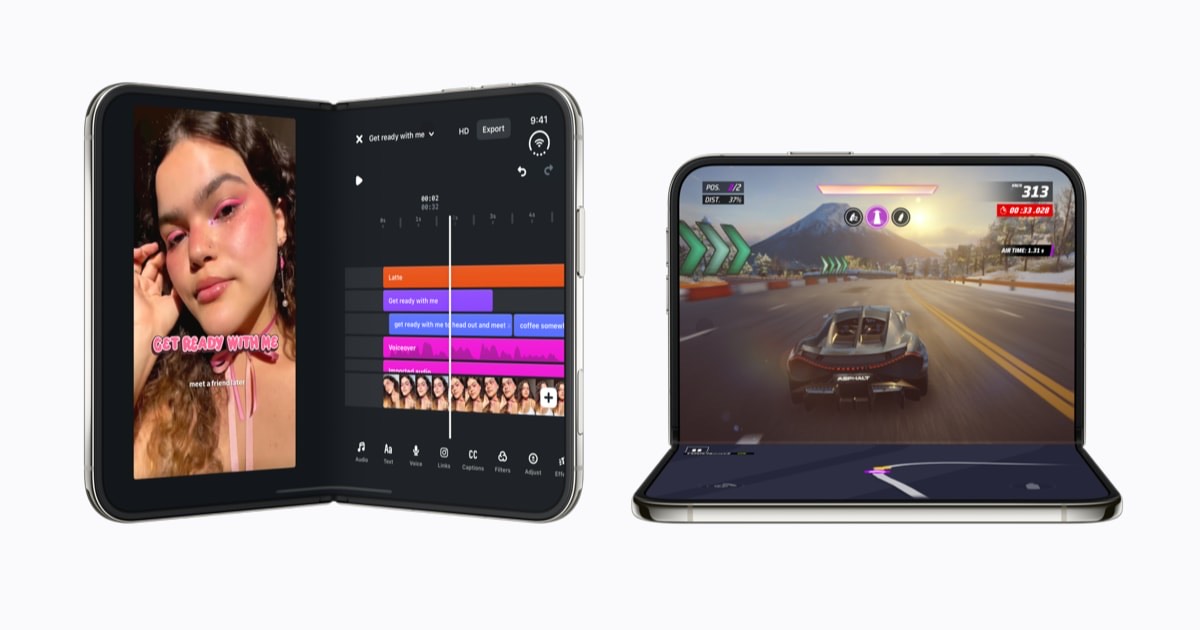
Apple said on 22 October 2026 that App Store product pages will carry a “Made for iPhone Duo” badge on apps built for the foldable’s two-screen layout, with curated editorial collections following on Friday, 23 October. The iPhone Duo is Apple’s first folding iPhone, announced 9 September with a 7.6-inch inner display and a 5.4-inch cover screen; it goes on sale 23 October from $1,999. Apple has not published an image of the badge, so the detail worth checking is how an app earns one: according to Apple’s developer documentation, submitting iPhone Duo screenshots in App Store Connect is what puts the badge on the page.
Key points
- The badge is self-service. Apple’s 5 October developer post, “Prepare and submit your apps for iPhone Duo”, states: “When you submit iPhone Duo screenshots in App Store Connect, your App Store product page will display a badge to let people know your app is optimized for iPhone Duo.” The post describes no review step.
- The threshold is an SDK, not an application. Apple’s iPhone Duo developer page splits apps three ways: built with iOS 27.1 or later, an app fills the inner display with toolbars and tab bars stacked vertically below the status bar; iOS 27 fills most of the inner display but avoids the status bar on the right edge; iOS 26 and earlier sits centered with empty space around it.
- April 2027 is the deadline. The developer post says “Starting April 2027, any apps or games submitted will need to include screenshots for iPhone Duo.” The App Store Connect screenshot specifications page puts it slightly narrower: “any app using the iOS 27.1 SDK or later.” The two scopes do not match.
Background
The hardware dates from 9 September. Apple’s launch release describes a 7.6-inch inner display, a 5.4-inch cover display covering 90 percent of the screen area of an iPhone 18 Pro, and a shared aspect ratio across both panels so content scales proportionally and picks up where it left off. Pre-orders opened 16 October; the phone ships 23 October in more than 70 countries and regions, with 28 more following on 30 October. Pricing starts at $1,999, or $83.29 a month over 24 months, in 256GB, 512GB, 1TB and 2TB capacities.
Apple’s developer preparation started earlier. The 22 October post says more than 2,000 developers have attended more than 50 in-person workshops in 19 cities, with further sessions planned for London, Mexico City, Montreal, Paris and Toronto. The tooling is in place too: Device Hub in Xcode 27.1 opens, closes, folds and rotates a simulated iPhone Duo so teams can test each pose. We covered Device Hub Pro on 22 October — a third-party macOS app that manages Android and iPhone simulators side by side, unrelated to Apple’s Device Hub despite the shared name.
The Duo is also not Apple’s only hardware this month. HomeView, the touchscreen home hub announced 13 October, sits in the same release cycle; the Duo is the most expensive piece of it and the one that depends most on other people’s software.
How the badge is earned
The Made for iPhone Duo badge and MFi are different programs. MFi covers hardware accessories — cables, headphones, game controllers. Apple’s MFi site lays out four steps, the third of which is certification: submit production-ready samples and packaging for review, and only after Apple approves the certification may a company manufacture and sell. That is why the MFi mark tells a buyer an accessory “has been certified by the developer to meet Apple performance standards.”
For the Duo badge, the published trigger is a screenshot submission. Apple has not said whether a human reviews it, and has published no application form, fee or rejection process. What the documentation does establish is that this is a display slot on a product page, switched on by the developer’s own submission. Apple has not defined it as a certification, and this entry does not either.
The engineering threshold is written down. Apple’s iPhone Duo developer page sets the three SDK tiers side by side:
| SDK used to build | Behavior when the device is open |
|---|---|
| iOS 26 or earlier | App runs centered with empty space around the window; when closed, content sits left of the status bar and camera |
| iOS 27 | Fills most of the inner display but avoids the status bar on the right edge |
| iOS 27.1 or later | Fills the display, with toolbars and tab bars stacked vertically below the status bar |
Only the third tier is what Apple calls optimized for iPhone Duo. Behind the badge is a build condition a developer can verify, not a subjective review.
Who is on the list
Apple’s 22 October post bolds 59 product names in the body, 58 of which are apps and services adapted for the Duo. The 59th is Apple Music, which shows up only as Deck-Man’s music library, then once more in the Apple One bundle list; neither mention is an adapted app. Only Apple TV among the 58 is Apple’s own. Apple gives no total; MacRumors ran the story as “More Than 50 Apps That Will Be Updated for iPhone Duo” and described “more than 50 third-party App Store apps,” which is the same third-party list.
The names break down by use. Streaming and sport: Netflix, Prime Video, Paramount+, Apple TV, MLB, PGA Tour. Work: Microsoft Word, Outlook, Zoom, Slack, Salesforce, Fantastical, Notewise, Things, Bear. Creation: Detail, Instagram, Edits, VLLO. Games: Asphalt Legends, Zenless Zone Zero, UnGodly, Sneaky Sasquatch, Retrocade, Deck-Man. Everyday services: NYT Cooking, LTK, Lowe’s, Shop, OpenTable, DoorDash, Yelp. Travel: Lyft, American Airlines, United Airlines, Flighty, Sky Guide, Tide Guide, edjing Mix, Next Shot.
Chinese and regional apps take a full section of the release: iQIYI, WPS Office, Xmind, Weibo, AMap, rednote and Taobao; WEBTOON, NAVER SERIES, KakaoTalk, KakaoPage and BAND in Korea; Airmail, Craft and Tiimo in Europe; Tripsy, SmartGym and Moises in Latin America.
Not all of them ship on day one. Apple says UnGodly arrives on the App Store in November, Zenless Zone Zero gets its update next month, Word and Outlook roll out a desktop-class experience “in the coming weeks”, and DoorDash puts delivery tracking on a larger map “later this year”. A badge is not a finished product.
What others say
The Verge’s Emma Roth notes that Apple has not shown what the badge looks like — the release describes what apps do with the two screens, not the mark itself. Her piece also warns that optimized is not the same as working: in The Verge’s own review, apps carrying the label, Instagram among them, still had bugs.
The review’s judgment is harsher. Nilay Patel and Allison Johnson sorted apps into three groups on 21 October: ordinary iPhone apps with no update, apps updated for iOS 27 that expand but were never designed for the panels (their “messy middle”), and fully updated Duo apps built against iOS 27.1. They found the first group still the vast majority, and said the middle group gives itself away with a black bar down the right side on the cover screen, space that real Duo apps fill with controls. The same review credits the fully updated apps where they exist, holding up Instagram’s Edits as the example.
John Gruber at Daring Fireball put the gap more bluntly. Using the device closed, he writes, the outer half is “by far, the worst iPhone Apple has ever made”; open, it is “my favorite tablet experience ever.” He does not dispute that the software is moving; he argues the split between the two states is inherent to folding.
The commercial brake comes from Thurrott’s Laurent Giret. He quotes Susan Prescott, Apple’s vice president of Worldwide Developer Relations — “The response to iPhone Duo from our developer community has been incredible” — then adds his own read: at $1,999, most developers will take their time on dual-screen work, and with the Duo sold out through the end of January according to Apple, there is no pressure to hurry.
Chinese coverage adds a translation wrinkle. cnBeta’s headline calls the badge an “exclusive app certification mark”, but the body describes no review process at all, only what the badge is for and which apps have one. Apple’s own text uses badge and “optimized for iPhone Duo”; the word certification does not appear.
Our take
For anyone shipping iOS, the thing to schedule is the date and the SDK tiers; the badge follows from them. From April 2027, submissions need Duo screenshots. If your project still sizes views from UIScreen.main or picks a layout from UIDevice.current.orientation, the question stops being whether to adapt. Apple’s developer page lists the specific patterns to hunt: replace UIScreen.main.bounds with view.bounds, compare the width and height of the space you have instead of reading device orientation, stop branching on userInterfaceIdiom == .phone, and stop treating horizontalSizeClass == .regular as shorthand for iPad.
One inconsistency needs your own judgment. The developer post draws the April 2027 line at submission; the screenshot specifications page draws it at the SDK. The scopes differ. Plan for the wider one, because nobody outside Apple knows which wording survives to next spring.
The badge itself is worth less than it looks. It is available to anyone who uploads screenshots, and it tells a shopper that an app was adapted for two screens, not that the adaptation is good. The apps in The Verge’s review that carry the label and still misbehave are the evidence. Teams that do the work properly get the badge as a side effect.
The open question should stay open: Apple has never said whether a person reviews the badge. The documentation describes submission alone, but “not documented” and “does not happen” are different claims, and planning next year’s release cadence is safer with this treated as unknown.
What to watch
23 October is the first check. Apple says the editorial collections go live that day, which makes the App Store the only place to see what the badge actually looks like and how widely it is applied. On 30 October, 28 more countries and regions start selling the device.
November brings the promised updates: UnGodly on the store, Zenless Zone Zero’s Duo build, Word and Outlook with their desktop-class layouts. If they arrive on schedule carrying the badge, the submit-and-it-appears mechanism is holding up in practice. If badges show up on apps that clearly are not adapted, Apple will probably have to explain what the mark means.
April 2027 is the hard date, a little over five months out, and screenshots are not something a recompile produces. They require an app to lay out correctly on both displays and in every folding angle. For teams still maintaining older projects, auditing for calls like UIScreen.main now costs less than doing it in March.