Microsoft ships a $2,599 RTX Surface
The Laptop Ultra ships October 16; a $5,999 Dev Box carries 128GB, and Copilot gains file control.
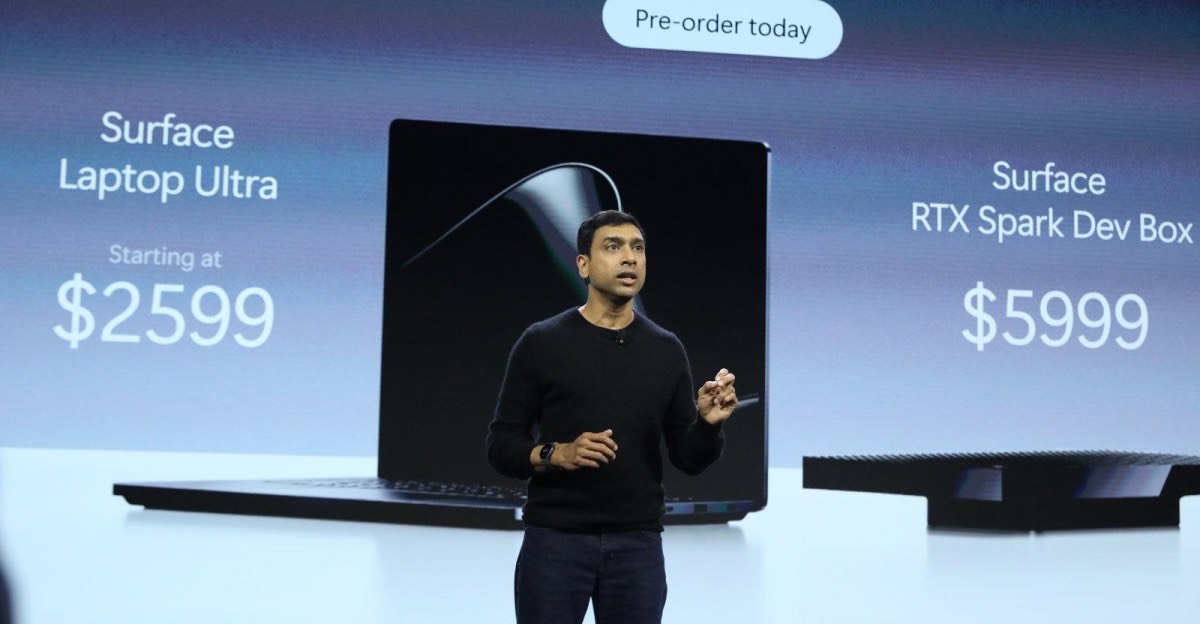
Microsoft’s Surface event on October 7 turned “local AI PC” from a concept into shelf inventory: the Surface Laptop Ultra carries NVIDIA’s RTX Spark chip, starts at $2,599, and ships October 16 — Bloomberg’s headline relayed Microsoft’s claim that it outperforms MacBooks. Alongside it came the Surface RTX Spark Dev Box with 128GB of unified memory at $5,999, and a magnetic USB-C charging port that reviewers immediately compared, favorably, to MagSafe. NVIDIA’s blog called it “a new beginning for Windows PCs.”
Key points
- Surface Laptop Ultra: RTX Spark, from $2,599, shipping October 16, magnetic USB-C charging
- Surface RTX Spark Dev Box: 128GB unified memory, $5,999, preorders open
- Windows side: Copilot gains deeper control of files and the system; local models plus sandboxed tooling land in the OS
- Positioning: a frontal strike at Apple’s M-series MacBook Pro price band and performance narrative
Copilot takes file control
The system-side news outweighs the hardware: Microsoft is granting Copilot deeper file and system control — local execution, cross-app operation, hybrid cloud inference. In a quarter full of agent overreach incidents, that is a striking counterpoint: the desktop agent’s permission boundary is being drawn by the OS vendor itself. Apple tightening disk access was defense; Microsoft’s play is grant-plus-boundary, and the two routes will be judged under security researchers’ magnifying glasses.
128GB of unified memory, as a signal
The Dev Box’s 128GB reflects the other fact of the memory-inflation era: the bottleneck for local models is capacity and bandwidth, not raw compute. With DGX Spark’s 128GB tier repriced to $6,950, Microsoft’s $5,999 Dev Box undercuts the reference directly — and the wider RTX Spark ecosystem (Acer, ASUS following on stage) anchors “personal AI workstation” pricing in a $2,600–$6,000 band.
The magnetic port, and what it signals
The detail that traveled furthest after the event was the magnetic USB-C port — Tom’s Guide declared it makes “MagSafe look obsolete.” The placement matters: Surface Ultra is competing on experience rather than spec sheets, a tacit admission that Apple’s laptop moat is the whole cloth, not the silicon. It is the first time the Windows camp has picked an industrial-design fight on Apple’s home turf instead of waiting for the reviewers to run the comparisons.
Software makes the hardware mean it
Alongside the machines, Microsoft shipped the missing half of local AI: models integrated directly into Windows, sandboxed local tool execution, and Copilot’s hybrid cloud-local routing. That responds to the real pain of local inference — getting the model running was never the hard part; wiring it to tools safely was. The sandbox turns “what a local agent may do” from a vendor promise into an OS-level constraint, the yin to the yang of Copilot’s newly granted file access.
Local AI hits its shipping moment
For the industry, the event supplies the first complete supply-chain story for local AI PCs — NVIDIA silicon, Windows integration, a Surface reference design, third-party machines. For buyers, the $2,599 entry price scopes it initially to developers and creators. Watch two things after the October 16 ship date: measured local-model throughput, and the first Copilot file-operation overreach cases. Those will decide whether local AI PC is a category or a slogan. The third-party machines matter here too: Acer and ASUS RTX Spark laptops shipping in the same window turn a Surface story into an ecosystem one, and ecosystem breadth is what separated “AI PC” from “PC” the last time the industry tried this naming.
One more consequence is worth naming: this launch explains the demand side of the memory price surge — when 128GB of unified memory becomes the entry spec for AI PCs, consumer memory demand has been permanently repriced upward. Microsoft and NVIDIA are, in effect, the largest buyers guaranteeing the floor under this year’s memory rally. One more consequence is worth naming: this launch explains the demand side of the memory price surge — when 128GB of unified memory becomes the entry spec for AI PCs, consumer memory demand has been permanently repriced upward.