Playbooks#Coding agent#Deep research#Prompts#Product Hunt#Market research#Indie hacking
Pipe Product Hunt into Codex and mine ideas people already pay for
The official Product Hunt connector in Codex, driven by a structured prompt from @goan999999, turns the last 30 days of launches, pricing pages and comment complaints into five opportunities for indie developers — each with competitors, pricing and a 7-day validation plan. For anyone who would rather mine real demand than brainstorm in a vacuum.
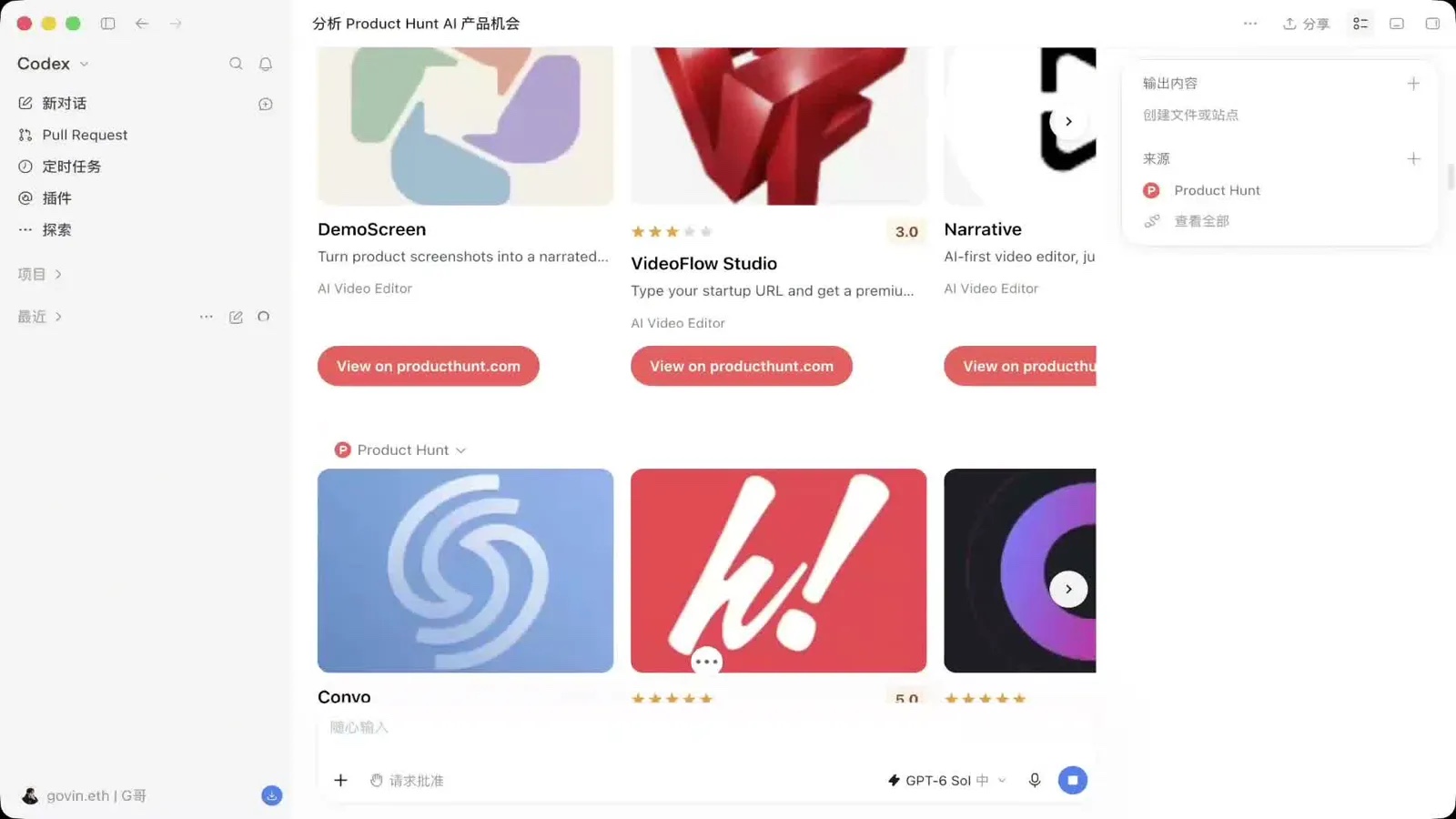
There are two classic ways to pick a side-project idea: stare at the ceiling until something comes, or ask an AI “what’s hot right now” and receive a list of safe generalities. In a demo posted on September 27, govin.eth (@goan999999) took a third route: install the official Product Hunt connector in the Codex desktop app, then have the agent read the last 30 days of launches, pricing pages and comment threads, and keep only the opportunities where people already pay but the existing options clearly fall short. The cover image above is a frame from his demo video.
Why Product Hunt: every launch ships with three hard pieces of evidence — a launch date, a pricing page, and real user comments. High-frequency complaints in those comments are more honest than any trend report, because paying for an imperfect solution is what proves demand is real. The author compresses his whole method into one line: find demand that already makes money, find what it fails to solve, then carve out a cheaper, simpler niche.
Three steps
-
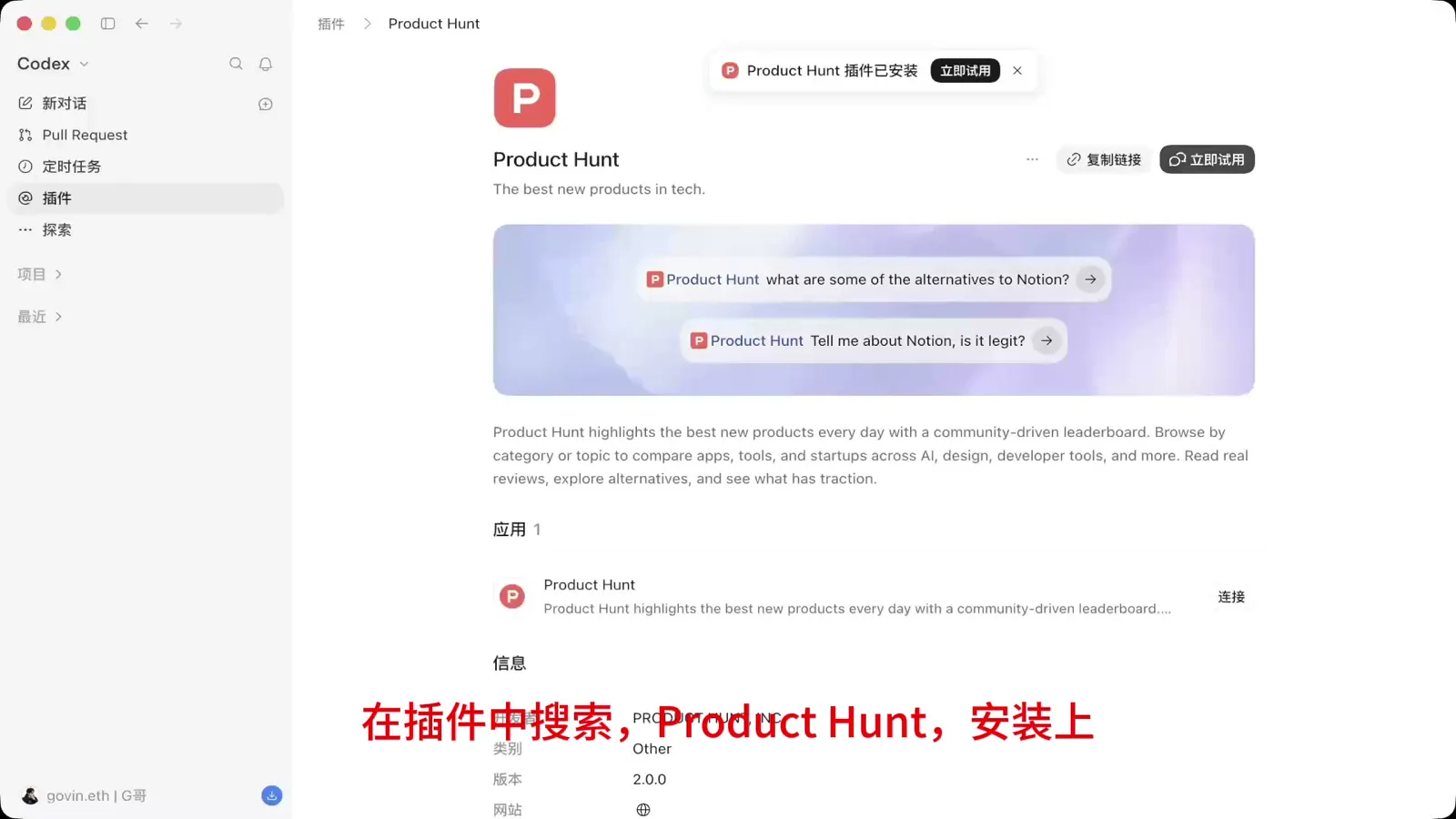
Install the connector: in the Codex desktop app, open the Plugins tab, search for Product Hunt, install and connect. The plugin page lists the developer as PRODUCTHUNT, INC., version 2.0.0.
-
Paste the prompt: the author published the full prompt in the original post with a note that anyone may use it as-is. Translated from the Chinese original (the tweet has the original text):
Using the Product Hunt plugin, analyze AI products launched or clearly trending in the last 30 days, focusing on AI agents, productivity tools, content creation, developer tools and sales automation. Shortlist 20 products worth studying; for each, analyze the core problem it solves, its target users, how it charges, why users pay, recurring complaints in the comments, competitor weaknesses and unmet needs. Then filter that down to 5 money-making opportunities an indie developer could enter. For each opportunity, output: the real user pain point, existing competitors, competitor weaknesses, a differentiated angle, a minimal MVP, suggested pricing, channels for the first users, and a 7-day validation plan. No generic startup advice — pick only opportunities with proven willingness to pay where existing solutions are clearly not good enough. Output each as: opportunity | user | pain point | competitors | market gap | MVP | pricing | acquisition | validation.
-
Wait for the run: in the video the task took a bit over 40 seconds. Codex first checks the plugin is reachable, then pulls the 30-day launches, pricing and comment text, separates “confirmed paying users” from “launch-day buzz”, and outputs five opportunities in the nine-column structure.
What the output looks like
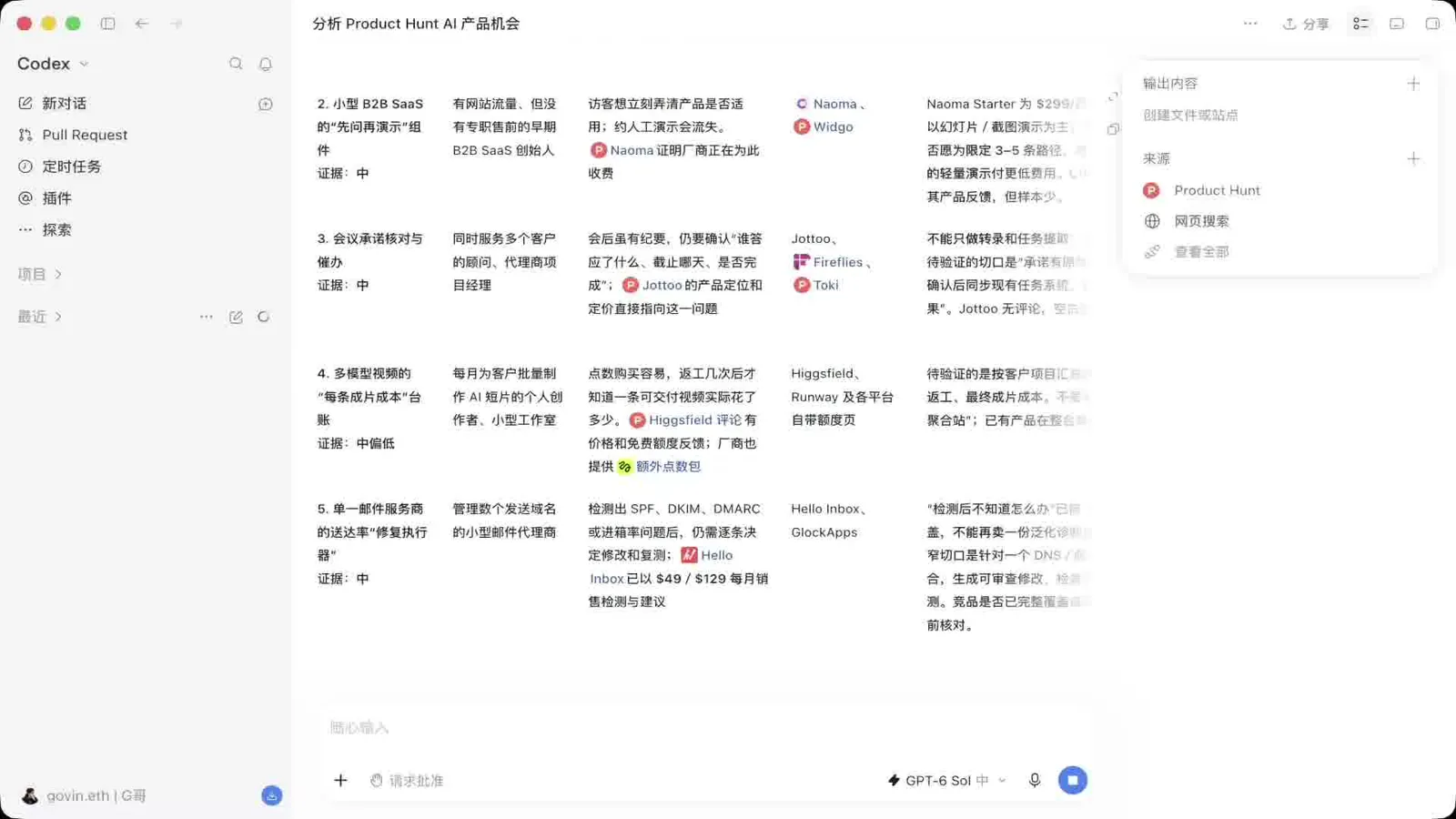
That run produced directions like an “ask before you demo” widget for small B2B SaaS, meeting-commitment tracking and follow-up, and a deliverability fix executor for single-provider email senders — each with a competitor list, suggested pricing and first-user channels. The detail worth stealing is the evidence grade: every opportunity is labeled “evidence: medium” or “evidence: medium-low”, and some rows flat-out say the evidence is too thin to propose a reliable indie entry point. The prompt only asks for opportunities with paying evidence; the model answered by grading its own evidence. Build that line into your own prompts.
Three caveats
- The income claim is the author’s own. He says this method brings him a six-figure income and is “worth at least 100k” — unverifiable, so treat it as motivation, not an expectation.
- Launch-day buzz is not recurring revenue. PH rankings, ratings and comment counts in the plugin reflect launch momentum; the prompt separates confirmed payers from buzz for exactly this reason. Check every price and competitor in the output against the actual PH pages.
- The output is a hypothesis; validation is the point. The 7-day validation plan and first-user channels attached to each opportunity are worth more than the opportunity itself — run the validation before writing code.
One more cost to plan for: a run pulls a lot of listings and comment threads, so it burns a noticeable chunk of your Codex usage.
Without Codex
Other coding agents can pull the same data. The producthunt skill by resciencelab wraps Product Hunt’s official GraphQL API into a set of read-only scripts; once installed in Claude Code, Codex or Cursor, the agent can query posts, comments, topics and collections directly — you just have to apply for a free developer token on Product Hunt first. The prompt itself is generic: change the opening “using the Product Hunt plugin” to “using the producthunt skill” and it runs the same way.
Start at the original post: copy the prompt, install the connector, and run your first nine-column output.