OXR: A 1.3B document parsing model that tops three benchmarks
SoMark's open-source OXR turns PDFs and images into coordinate-tagged Markdown/JSON with 1.3B parameters, claiming #1 on three parsing benchmarks.
Project facts
GitHub Ecosystem- License
- Apache-2.0
- Language
- Python
- Stars
- 2,801
- Data checked
- 2026-11-01
Snapshot figures reflect the check date and may change over time.
Feeding documents to agents is not about reading text — it’s about not losing structure: formulas, tables, reading order. OXR (Optical Everything Recognition) is an open-source document parsing model from the SoMark team that takes PDFs or document images and emits Markdown or JSON with layout coordinates, covering 13 element types including tables, formulas, code blocks, and chemical structures. The team reports #1 rankings on olmOCR-Bench, OmniDocBench, and DocParsingBench, with the widest lead in table parsing. Created on GitHub on October 5, 2026, the repository had 2,801 stars by November 1; the OXR-1.0 weights are on Hugging Face (roughly 3,500 downloads), under Apache-2.0 with added commercial terms (see below).
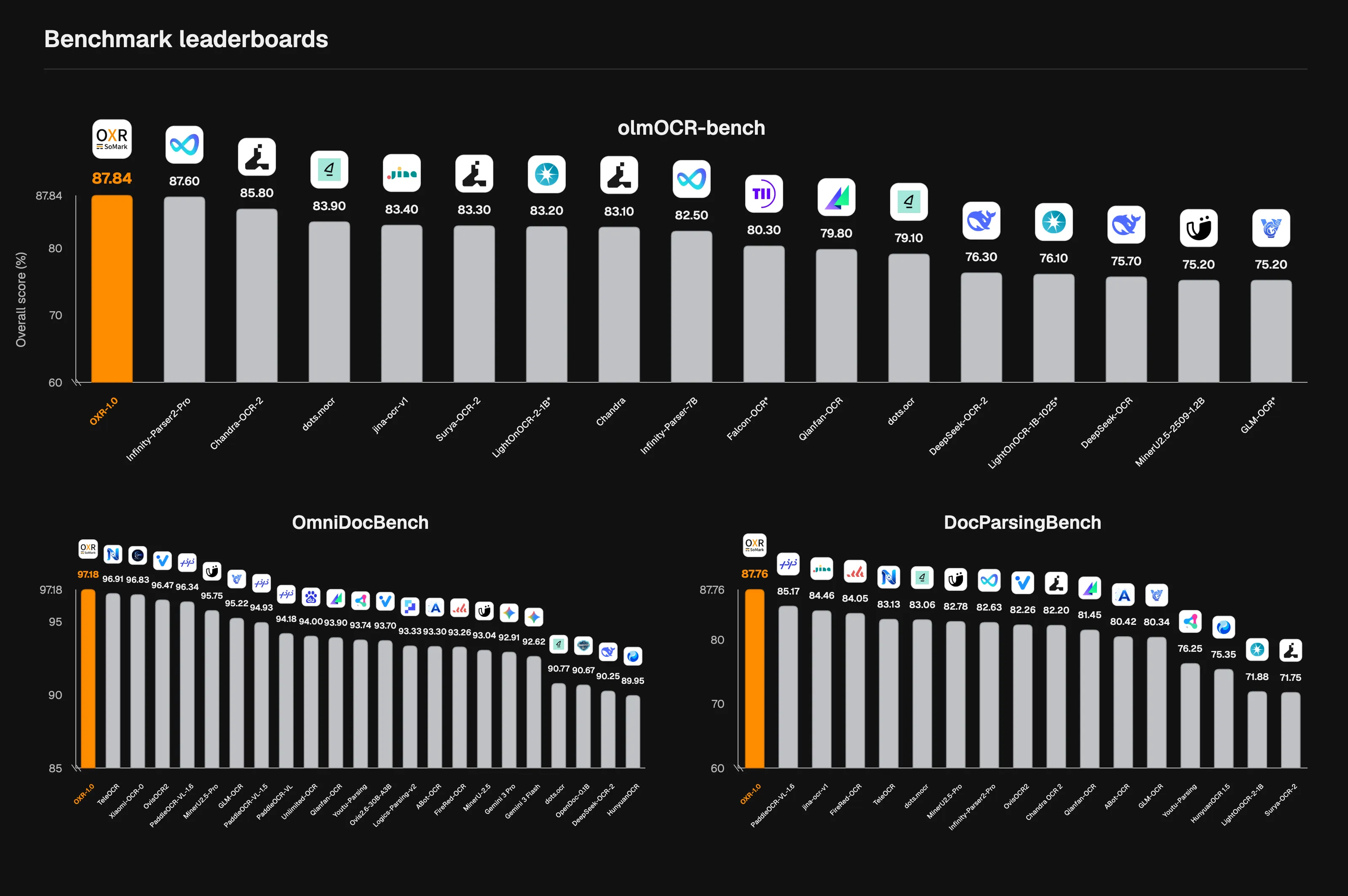
Benchmarks
Keep the provenance straight: these rankings come from the team’s own evaluation charts (above), the competing-model list is the team’s selection, and no independent replication exists yet — the paper badge says arXiv “Coming Soon,” so no peer review either. The three boards measure different things: OmniDocBench spans document layouts and reading order, olmOCR-Bench checks specific items like whether key text and table relations survive, and DocParsingBench scores parsing quality. On speed, the team reports fastest among open-source parsing models on an RTX PRO 6000.
Core features
OXR is pretrained from scratch and uses a recursive self-improvement (RSI) loop during post-training — a first in document parsing, per the team. The system is two models: a layout-analysis model and a recognition model, with reading order folded into recognition so one model handles both, which they credit for gains in speed and accuracy. The layout module is independently pluggable, so you can swap in your own. At 1.3B parameters, it runs on a single GPU without a 7B-class memory budget.
Typical use cases
- Teams feeding papers, contracts, or reports into a RAG knowledge base: formulas become LaTeX, tables become HTML, and every block carries coordinates back to the source page.
- Self-hosted pipelines where sensitive documents can’t leave the building: 1.3B parameters run on one GPU, weights on Hugging Face.
- Applications that want a swappable parsing backend: the layout-analysis module is pluggable and can be replaced with your own model.
Try before installing: the online demo at free-oxr.somark.ai needs no registration, and the Free API needs no key — though the team explicitly discourages production use, with no stability guarantee and queued requests. For how parsed documents flow into agent pipelines, see our earlier coverage of openSRE — the same “documents in, structured data out” design.
Quick start
pip install somark
Weights come from Hugging Face (SoMarkAI/OXR-1.0; inference can run on vLLM with the out-of-tree plugin the repo ships). Without installing anything, open the demo at free-oxr.somark.ai and upload a PDF to see the parse. The Free API needs no key but isn’t recommended for production — queued requests, no stability guarantee.
Watch the license
OXR’s LICENSE is Apache-2.0 with additional terms, which we read in full: commercial use requires a separate license once your company exceeds USD 2 million in total funding or annual revenue; offering an online service requires “not affiliated with SoMark” attribution; and running a hosted parsing API that competes with SoMark’s is prohibited. Individual use, research, and startups under the thresholds are unaffected — but read all three clauses before your company grows into them.
Summary
OXR fits teams converting documents into agent-ready data at scale: formulas and tables survive intact, coordinates enable traceability, and 1.3B parameters keep self-hosting cheap. The judgment to make is theirs to verify: benchmark claims are currently team-reported, so waiting for the arXiv paper or third-party replication is reasonable, and the three commercial clauses are required reading before adoption. GitHub data verified November 1, 2026.